Top 100 Product Managers #46 | Eric Yuan: Rejected for a US Visa 8 Times, He Left Cisco to Rebuild Video Calls and Turned One Frictionless Link into Global Infrastructure
In the spring of 2011, Silicon Valley venture capitalists heard a pitch that sounded like career suicide: Eric Yuan, Corporate VP of Engineering at Cisco overseeing WebEx, had just resigned from his seven-figure executive role to build a new video conferencing app from scratch.
Nearly every top firm on Sand Hill Road politely passed. Their reasoning was unanimous: “Video conferencing is the most crowded, commoditized graveyard in software. Enterprises already have your old employer Cisco’s WebEx and Polycom; consumers have Microsoft’s Skype, Google Hangouts, and Apple FaceTime. Why on earth does the world need another video chat tool?”
Eight years later, in April 2019, Zoom went public on NASDAQ at a $16 billion valuation. Less than a year after that, when the COVID-19 pandemic brought the physical world to a standstill, Zoom’s daily meeting participants surged from 10 million to 300 million in ninety days, keeping schools, hospitals, enterprises, and families connected across the planet.
In a red-ocean market guarded by four trillion-dollar tech giants, how did Eric Yuan build the product that won?
On the doaipm.com Top 100 Product Managers Ranking, Eric Yuan holds #46 (87 OVR: Insight 92 / Taste 92 / Scale 90 / Business 88 / Vision 85 / Originality 78). Let’s break down how an engineer who was rejected for a US visa eight times beat Silicon Valley’s giants with radical simplicity.
1. Ten-Hour Train Rides and Eight Visa Rejections
Born in Tai’an, Shandong in 1970, Eric Yuan spent his college years taking grueling 10-hour standing-room-only train rides to visit his girlfriend (now wife) in Beijing. Stuck in those crowded train cars, he daydreamed about a device that could let people see and talk to each other in one click without traveling for ten hours.
After hearing Bill Gates speak in Tokyo in 1994, Yuan resolved to move to Silicon Valley. His US visa application was rejected. He reapplied—and was rejected again. Over two years, he was rejected eight times in a row, succeeding only on his ninth attempt.
In 1997, he joined WebEx as one of its founding engineers. After Cisco acquired WebEx for $3.2 billion in 2007, Yuan rose to VP of Engineering managing over 800 engineers.
2. The Insight: “Every Giant Had a Product, Yet Not One Customer Was Happy”
As a Cisco executive, Yuan spent years visiting Fortune 500 CIOs and everyday users. What he found haunted him: not a single WebEx customer smiled when talking about the product.
Built in the late 1990s for desktop screen-sharing over wired networks, WebEx choked on mobile devices and multi-stream video. Yet when Yuan proposed rewriting the architecture from the ground up, Cisco’s leadership refused to cannibalize its legacy cash cow.
In April 2011, Yuan walked away with 40 engineers to build what customers actually wanted.
3. Three Anti-Incumbent Product Decisions
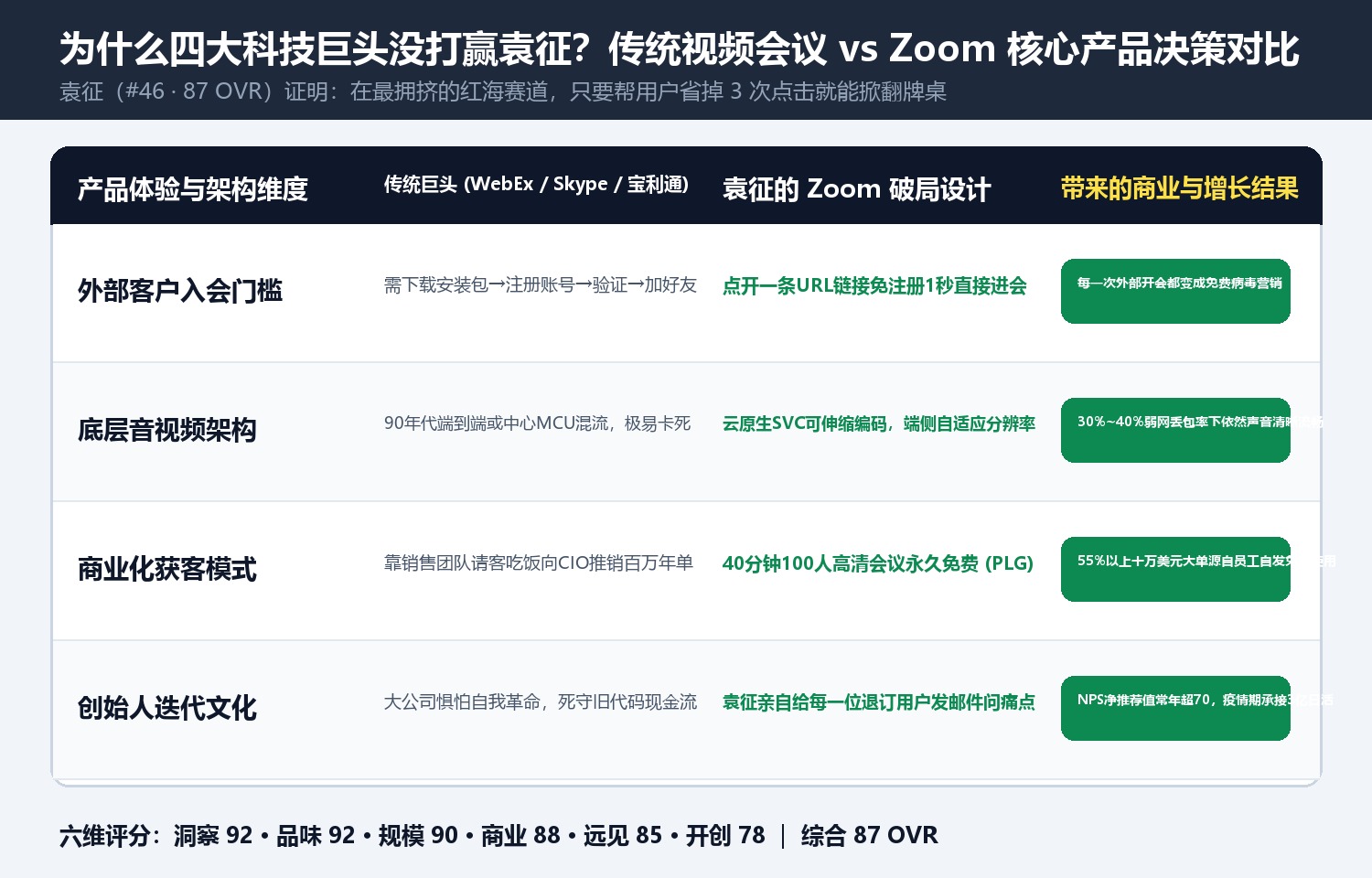
- One-Click URL Join (Zero Registration Wall for Guests): Skype and WebEx forced every invitee to download installers, create accounts, verify emails, and add contacts before joining a call. Yuan decoupled the host from the guest—anyone could click a
zoom.uslink and be face-to-face in one second without creating an account. - Client-Side Multimedia Routing That Survives 30% Packet Loss: Instead of transcoding every stream on a fragile central MCU server, Zoom dynamically routed scalable video streams (SVC) matched to each device’s bandwidth and screen size, keeping audio crystal clear even on spotty hotel Wi-Fi.
- The Gold Standard of Product-Led Growth (PLG): By offering 40-minute 100-person HD meetings completely free, Zoom turned every external meeting into a live product demo. Over 55% of Zoom’s $100k+ enterprise accounts started with a single employee using the free tier.
Discussion