Time-Traveler's Guide: How to Distill 98% Concentrated Sulfuric Acid ('Mother of Industry') from Pharmacy Green Vitriol in a Clay Retort
If you travel back in time to pre-industrial antiquity, soap, 75% alcohol, cement, and soda-lime glass will make you wealthy. But the moment you try to cross the threshold into modern industrial civilization—to manufacture water-soluble phosphate fertilizers, lead-acid batteries, hydrochloric acid, or nitric acid for smokeless gunpowder and percussion caps—you will hit a brick wall:
Every single one of those technologies requires the “Mother of All Industries”: Concentrated Sulfuric Acid (H₂SO₄).
How do you produce 95%+ concentrated sulfuric acid in an era with no platinum/vanadium catalysts and no modern chemical plants? In Issue #09 of our Time-Traveler’s Guide, we turn to Song Yingxing’s 1637 encyclopedia Tiangong Kaiwu (天工开物·燔石) and the 16th-century European Nordhausen Vitriol Process to show how you can buy cheap emerald-green crystals (Green Vitriol / 青矾) from any ancient pharmacy or dye house and distill fuming sulfuric acid (Oil of Vitriol) in a glazed stoneware retort.
1. Strategic Value: Why One Jar of Sulfuric Acid Unlocks the Entire Tech Tree
Because concentrated sulfuric acid has an exceptionally high boiling point (337°C) and is non-volatile, pouring it onto common ancient salts immediately unlocks the other two mineral acids:
- Sulfuric Acid + Common Salt (NaCl) → Hydrochloric Acid (HCl);
- Sulfuric Acid + Saltpeter (KNO₃) → Fuming Nitric Acid (HNO₃) (unlocking nitrocellulose smokeless powder and nitroglycerin);
- Sulfuric Acid + Burned Animal Bones → Superphosphate Fertilizer (doubling crop yields);
- Dilute Sulfuric Acid + Lead Plates → Rechargeable Lead-Acid Battery (unlocking telegraph networks and electroplating).
2. The Underlying Chemistry: Self-Redox Cracking of Green Vitriol
Long before the modern Contact Process, sulfuric acid was called Oil of Vitriol because it was distilled directly from Green Vitriol (Iron(II) sulfate heptahydrate, FeSO₄·7H₂O):
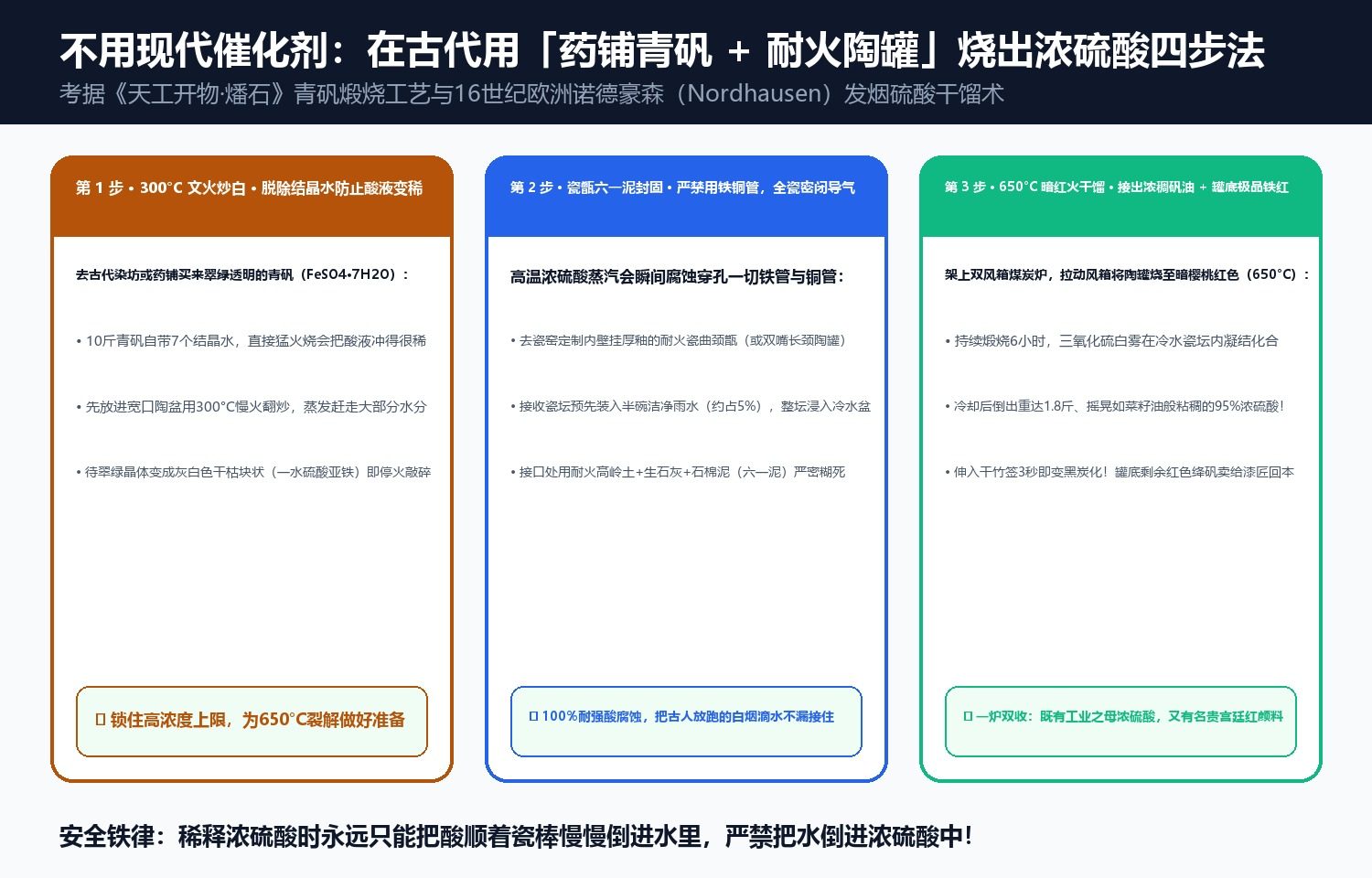
- Stage 1 — Gentle Dehydration (300°C): Heating emerald-green FeSO₄·7H₂O drives off 6 molecules of water of crystallization so excess steam won’t dilute your final acid, yielding greyish-white monohydrate (FeSO₄·H₂O).
- Stage 2 — High-Temperature Dry Distillation (650°C–700°C): Inside a sealed stoneware retort heated to a dark cherry-red glow (650°C), iron(II) undergoes internal redox disproportionation—reducing half of the sulfate into SO₂ while oxidizing itself to iron(III) oxide (Venetian red pigment, 绛矾) and expelling pure sulfur trioxide gas (SO₃): 2FeSO₄·H₂O (650°C) → Fe₂O₃ + SO₂↑ + SO₃↑ + 2H₂O↑
When the expelled SO₃ gas hits the small starter pool of water in your cooled ceramic receiver, it hydrates into oily, dense 95%–98% concentrated sulfuric acid (density 1.84 g/cm³)!

3. Historical Sources & Step-by-Step Verification
In Tiangong Kaiwu, Song Yingxing documented how ancient Chinese artisans roasted green vitriol (Qingfan) in open pots to produce red iron oxide pigment (Jiangfan / 绛矾) for royal lacquerware—unknowingly venting clouds of priceless sulfur trioxide into the sky! By simply enclosing the roasting vessel in a glazed ceramic retort luted with fireclay and dipping a dry bamboo sliver into the collected oily liquid (which instantly turns jet-black via cellulose dehydration), you have unlocked the chemical foundation of the modern world.
Discussion