Before 2013, an Aerial Shot Cost $10,000 for a Helicopter: How the White DJI Phantom Drone Conquered 70% of the World's Skies
Before 2013, if an independent filmmaker wanted a 10-second sweeping aerial shot over a coastline or mountain ridge, they had to rent a full-scale helicopter and a gyro-stabilized cinema rig for $10,000 to $30,000 a day. Meanwhile, hobbyist multirotor drones were a soldering-iron nightmare: you bought bare carbon-fiber frames, four ESCs, four brushless motors, and a raw flight controller board, spent three days tuning PID loops on a PC, and watched it flip into the dirt on its first gust of wind.
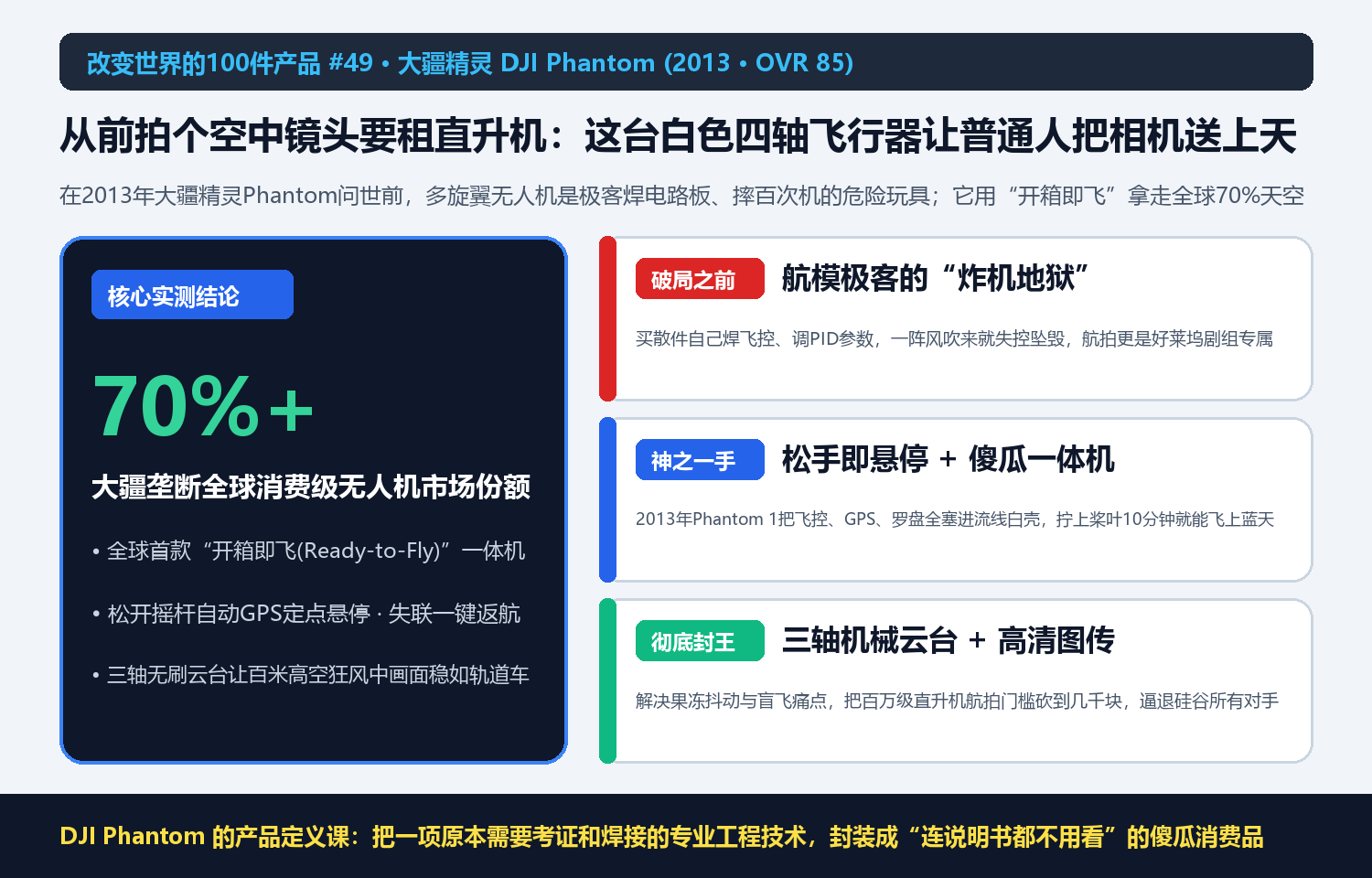
Then in January 2013, Shenzhen-based DJI launched the DJI Phantom—an iconic white quadcopter that worked Ready-to-Fly (RTF) right out of the box. If you panicked in mid-air and let go of the sticks, it simply hovered in place like it was nailed to the sky. Within three years, the Phantom series propelled DJI to over 70% global market share, wiping out heavily funded Silicon Valley rivals like 3D Robotics and GoPro Karma. At #49 (OVR 85) on our 100 Greatest Products list, we dissect the Phantom’s three product breakthroughs.
1. Killing the Soldering Iron: From B2B Flight Controllers to “Ready-to-Fly”
Before the Phantom, DJI was already profitable selling high-margin flight controllers (Wookong and Naza) to DIY hobbyists. Founder Frank Wang realized that while only 100,000 geeks knew how to solder a drone, hundreds of millions of creators wanted a flying camera.
The original $679 DJI Phantom 1 hid all wiring inside a friendly white shell, pre-calibrated the GPS and compass at the factory, and introduced a revolutionary interaction primitive: letting go of the joysticks meant “brake and hover in place.” Anyone could fly it in five minutes.
2. Full-Stack Vertical Integration: 3-Axis Brushless Gimbals & Lightbridge
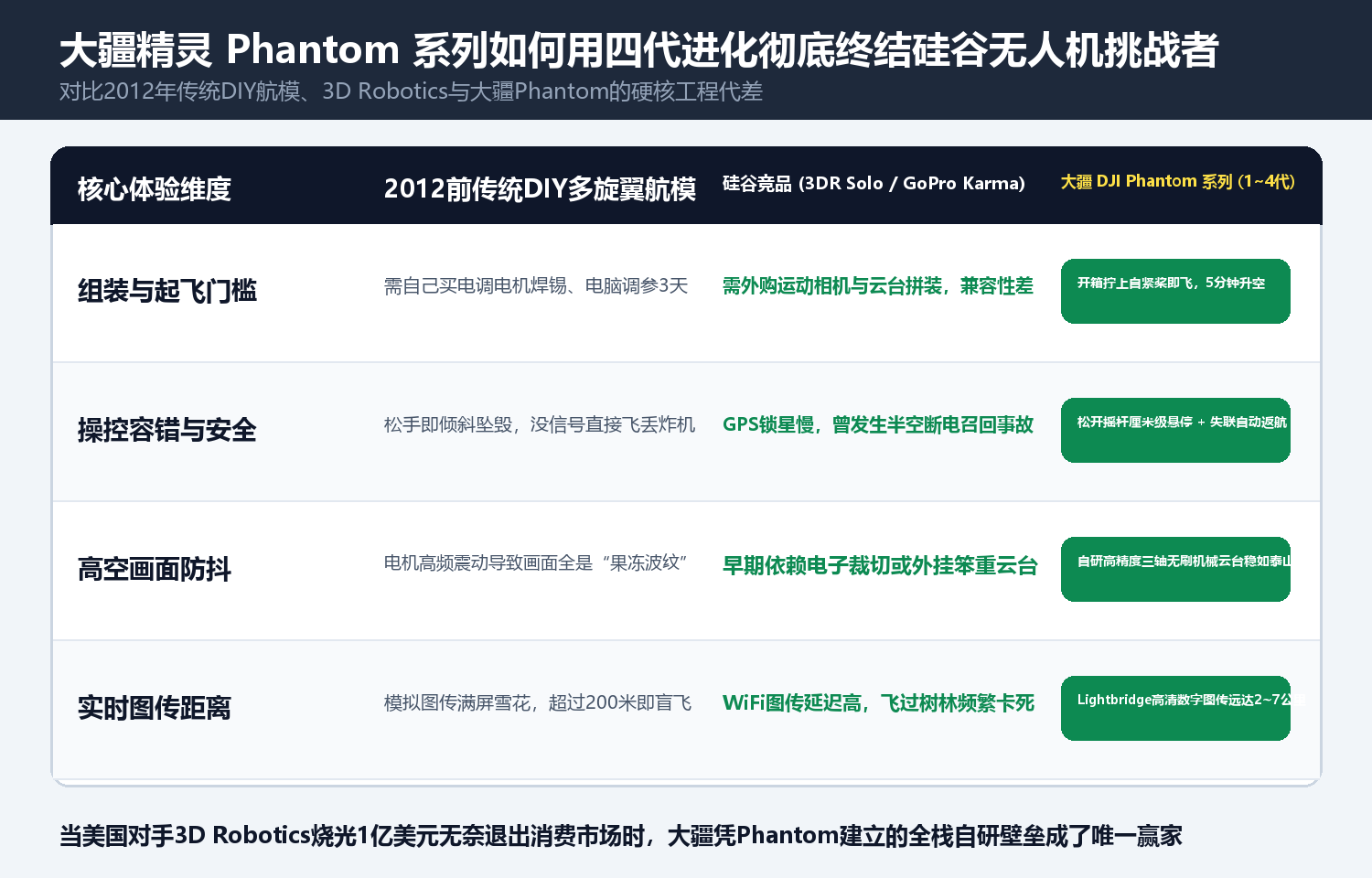
When Silicon Valley competitors like 3D Robotics ($100M+ raised) and GoPro tried to compete by assembling off-the-shelf components, DJI crushed them through relentless vertical integration across Phantom 2, 3, and 4:
- Zenmuse 3-Axis Brushless Gimbal: Eliminated high-frequency motor vibration (“jello effect”), delivering tripod-steady footage in 30 mph winds;
- Lightbridge Digital Video Downlink: While rivals relied on laggy 200-meter Wi-Fi, DJI beamed live HD video from 3 miles away directly to a smartphone screen;
- Stereo Vision Obstacle Avoidance (Phantom 4): Made the drone smart enough to brake automatically in front of walls and trees.
By wrapping military-grade control theory, optics, motors, and RF silicon into a foolproof consumer appliance, the DJI Phantom permanently changed how humanity sees the Earth from above.
Discussion