Product Rank #49: The mRNA Vaccine (86 OVR) — Demoted and Evicted from Her Lab at 40, Katalin Karikó Turned Medicine into Programmable Software
In the autumn of 1995, 40-year-old Hungarian-born biochemist Katalin Karikó experienced the darkest week of her life. After dozens of rejected grant applications for her work on messenger RNA (mRNA), the University of Pennsylvania demoted her off the tenure track, cleared out her lab, and cut her pay below that of a lab technician—all in the same week she underwent surgery for suspected cancer.
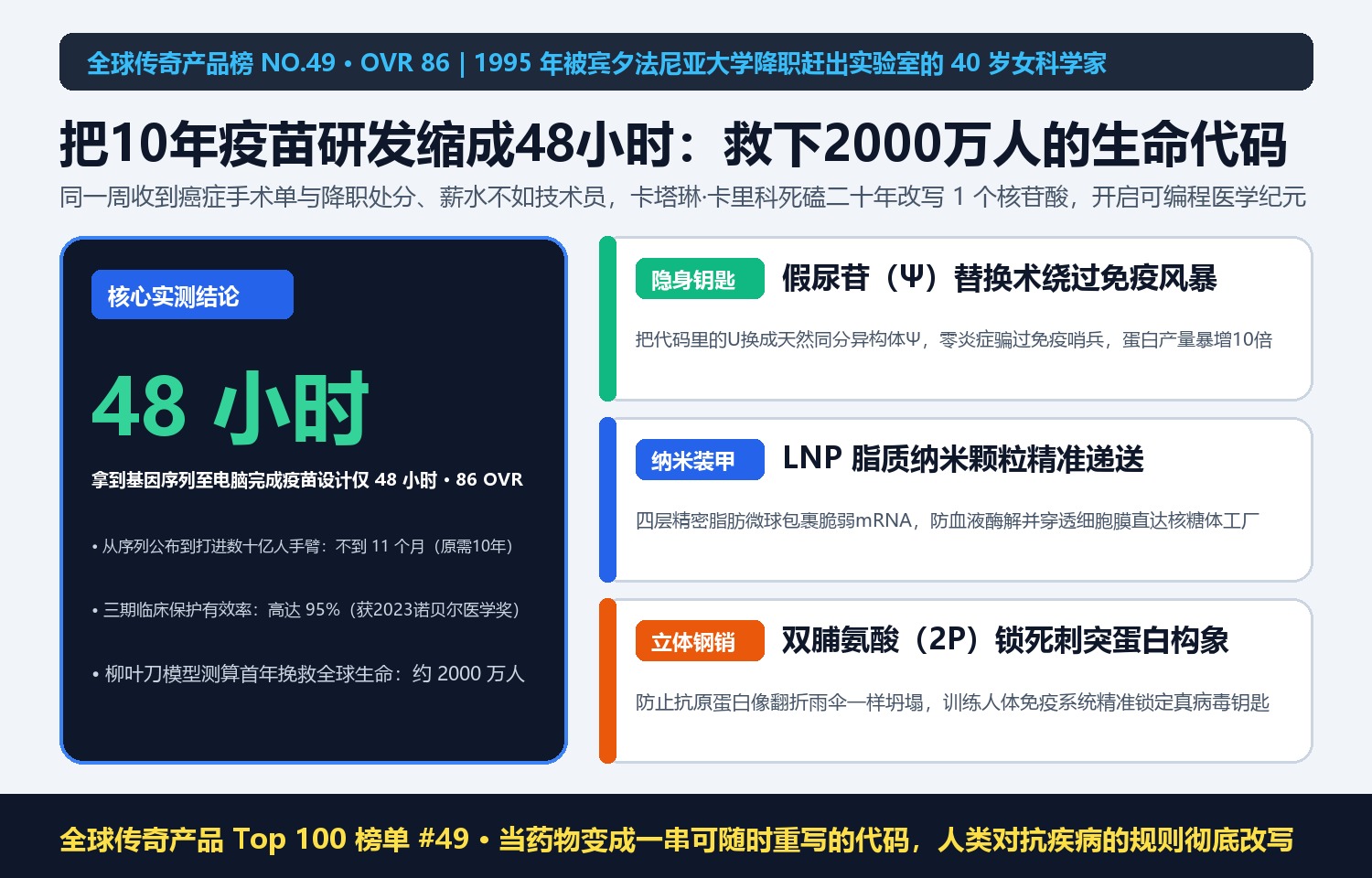
Yet she refused to quit. In 2005, she and Drew Weissman discovered that substituting pseudouridine (\Psi) for uridine allowed synthetic mRNA to slip past the body’s innate immune sensors without triggering a lethal inflammatory storm.
Fifteen years later, when the SARS-CoV-2 genetic sequence was posted online in January 2020, scientists designed the mRNA vaccine sequence on a computer in 48 hours and delivered an FDA-authorized, 95%-effective vaccine to billions of arms in under 11 months—shattering the 10-year rule of vaccine development.
In the doaipm.com Top 100 Products rankings, the mRNA COVID Vaccine ranks #49 with an 86 OVR (92 Originality, 92 Impact).
1. From Analog Virus Farming to Digital Programmable Medicine
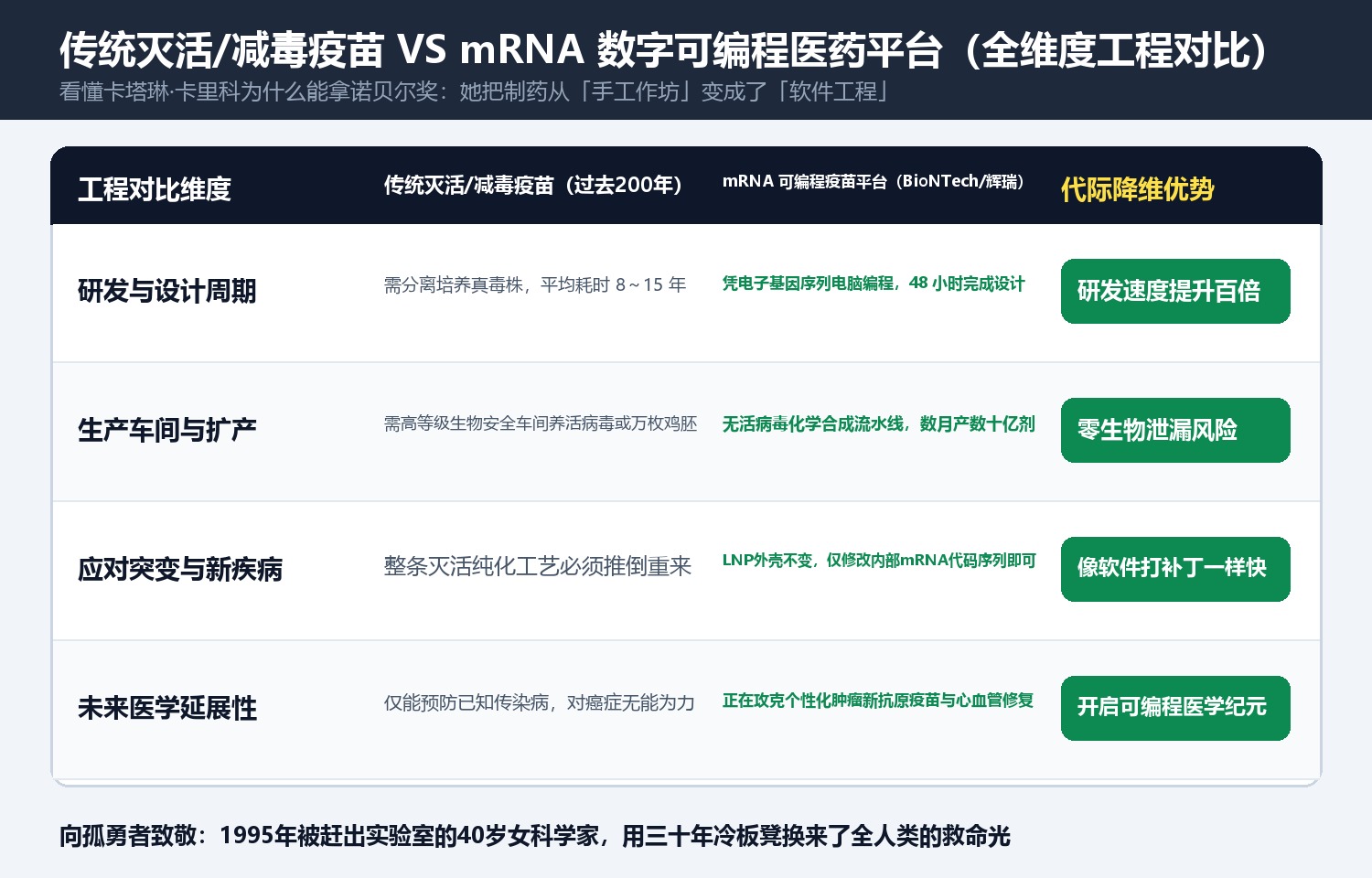
Traditional vaccines require growing, killing, and purifying live pathogens in vats—a bespoke hardware process that takes years for every new pathogen. mRNA decouples the delivery hardware (Lipid Nanoparticles, LNP) from the instruction software (the A/U/C/G sequence), turning the human ribosome into an on-demand 3D printer for any antigen.
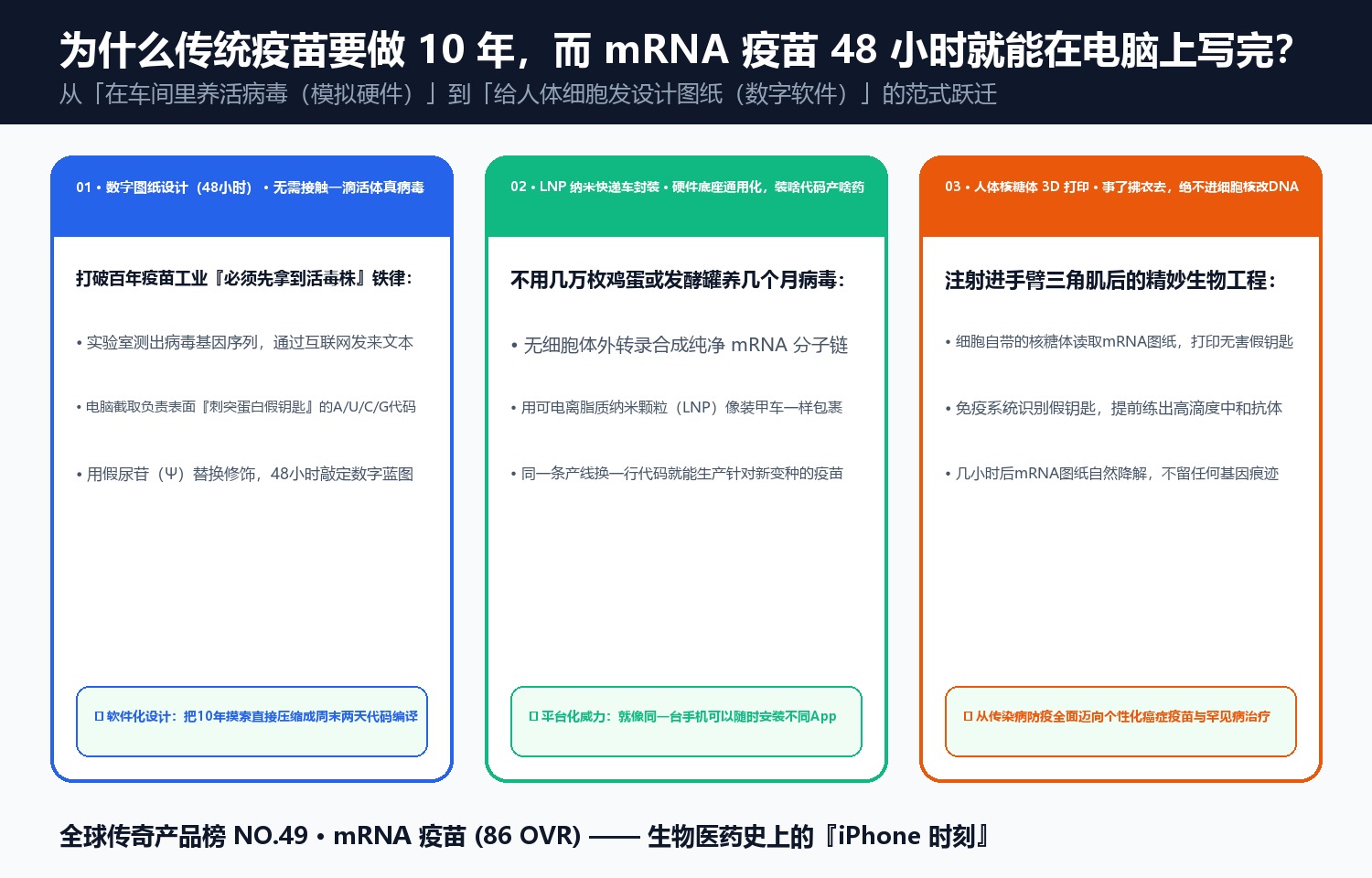
2. Three Engineering Walls Broken: Pseudouridine, LNP Armor, and 2P Prefusion Lock
By combining Karikó’s pseudouridine stealth modification, ionizable lipid nanoparticles, and the 2P spike-protein stabilization lock, the mRNA platform inaugurated a new era of programmable medicine now expanding into personalized cancer vaccines and rare genetic therapies.
Discussion