100 Products That Changed the World #37 | Adobe Photoshop (1990): How a PhD Student's Basement Code Introduced Layers and Ruled Visual Culture for 36 Years
In the history of commercial software, there is one ultimate linguistic test of dominance: did your product’s proper noun become a universal verb?
Only a handful of products have ever crossed that threshold. Searching the web became Googling. And whether in a Manhattan fashion magazine, a Hollywood VFX studio, or an e-commerce studio in Hangzhou, altering an image has had a single name for three decades: to Photoshop it.
Since Adobe released Photoshop 1.0 on February 19, 1990, this software ended the century-old chemical darkroom era, rendered phrase “pics or it didn’t happen” obsolete, and survived every technological wave from desktop publishing to mobile apps and generative AI.
On the doaipm.com 100 Products That Changed the World Ranking, Photoshop ranks #37 (88 OVR: Durability 93 / Impact 92 / Originality 90 / Business 87 / Scale 85 / Experience 79). Let’s examine how two brothers built it in their father’s basement—and why its architecture remained untouchable for 36 years.
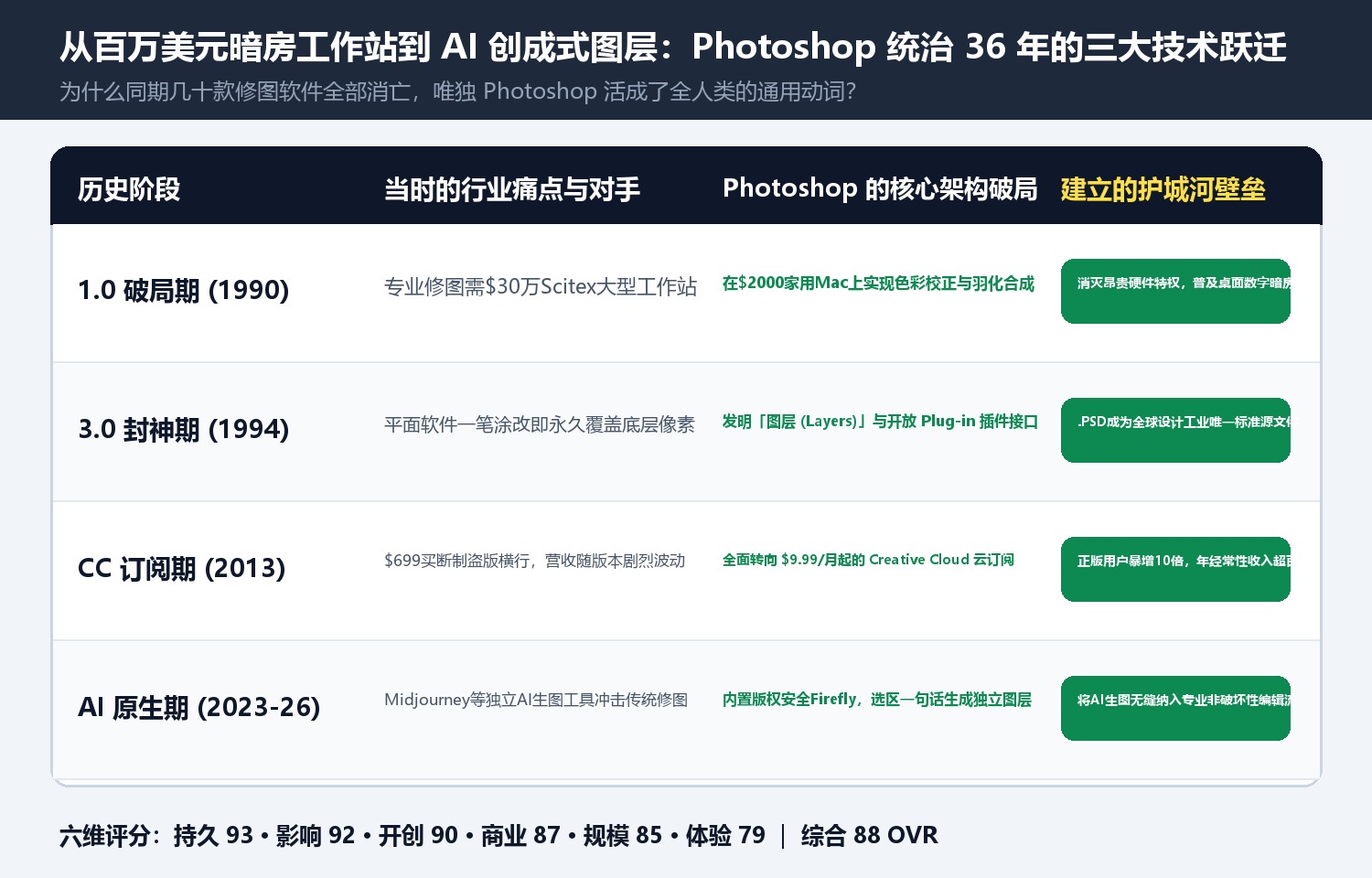
1. From a $300,000 Scitex Room to a Basement Mac Plus
In 1987, professional digital photo retouching required a dedicated Scitex or Quantel Paintbox workstation costing $300,000 to $1,000,000, billed at hundreds of dollars per hour.
That year, University of Michigan PhD student Thomas Knoll wrote a small subroutine in his father’s basement darkroom called Display to simulate grayscale images on his black-and-white Macintosh Plus. When his brother John Knoll—a visual effects supervisor at George Lucas’s Industrial Light & Magic (ILM)—saw it, he realized Thomas’s $2,000 Mac was doing what ILM’s six-figure Pixar image computers did.
John became the ultimate seed user and product manager, pushing Thomas to add gamma correction, feathered selections, color balance, and file export. By 1988, Photoshop was born.
2. Three Product Decisions That Built a 36-Year Moat
- Photoshop 3.0 (1994) and the Invention of “Layers”: Before Layers, painting a pixel over an image destroyed the underlying pixel forever. Inspired by traditional cel animation, Thomas Knoll introduced non-destructive layered composition, turning the
.PSDfile into the universal lingua franca of global design collaboration. - An Open Plug-in Architecture from Day One: Knowing a two-man team could never write every filter or scanner driver, the Knoll brothers exposed an open plug-in API that spawned thousands of third-party extensions.
- The 2013 Creative Cloud Pivot & Native Generative AI: Ditching the $699 boxed license for a $9.99/month subscription expanded Adobe’s addressable market tenfold, while embedding Firefly Generative Fill directly as editable layers kept Photoshop at the center of the AI era.
Discussion