He Productized the Entire Planet Twice: After Building Google Earth and Google Maps, He Turned the Real World into Pokémon GO at Age 50
In Silicon Valley history, building a single billion-user product is enough to cement a legend. But only one person in history has productized the entire planet Earth twice: John Hanke.
- First (2001–2010): He put the Earth inside our screens. As founder of Keyhole—acquired by Google in 2004 to become Google Earth—and VP of Google’s Geo division for seven years, Hanke oversaw Google Maps, Street View, and the iconic Maps app that Steve Jobs demoed live on stage at the 2007 iPhone launch.
- Second (2011–2016+): When every other tech company was competing to trap human eyeballs on living-room couches, a 49-year-old Hanke spun out Niantic and launched Pokémon GO—turning the physical planet into a game board, shattering five Guinness World Records, and grossing over $6 billion.
At #57 (OVR 85) on our 100 Greatest Product Managers list, we examine Hanke’s 20-year compounding product flywheel.
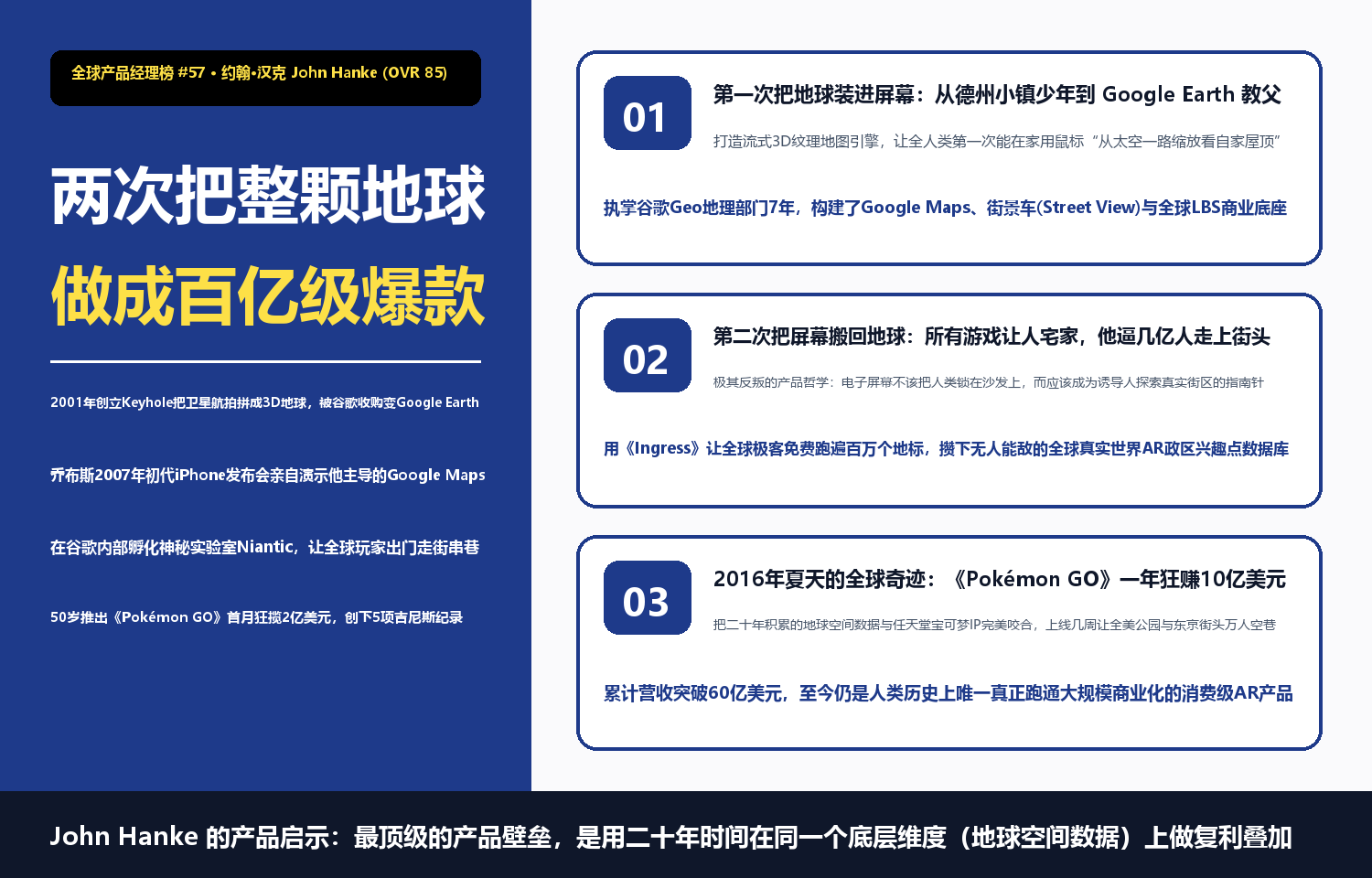
1. Stage One & Two: From Keyhole’s 3D Texture Streaming to the iPhone’s Map Foundation
Raised in a tiny Texas town of 1,000 people, Hanke co-founded Keyhole in 2001 to stitch satellite imagery onto a 3D streaming globe using video-game texture engines. For the first time in human history, anyone could zoom smoothly from outer space down to their own backyard rooftop in three seconds.
After Google acquired Keyhole in 2004, Hanke spent the next six years building the spatial backbone of the mobile internet: launching Google Maps, deploying fleets of Street View camera cars across millions of miles of road, and working directly with Steve Jobs to ship Maps on the original 2007 iPhone.

2. Stage Three & Four: Why Rivals Couldn’t Copy Pokémon GO—The Hidden Ingress Moat
When Pokémon GO exploded in July 2016—reaching $600 million in revenue in just 80 days (3x faster than any mobile game in history)—dozens of studios tried to clone it by slapping GPS coordinates onto an IP. Nearly all of them failed.
Why? Because they missed Hanke’s four-year secret weapon: Ingress (2012). Before touching Pokémon, Hanke built Ingress, a sci-fi territory game that crowd-sourced over 15 million player-submitted photos and GPS coordinates of real-world murals, statues, post offices, and parks across the globe. Those 5 million human-verified, pedestrian-safe cultural landmarks became the PokéStops and Gyms of Pokémon GO—proving that the deepest product moats are built by compounding domain data over decades.
Discussion