Top 100 Product Managers · #55 Frank Wang (86 OVR): A C-Grade Thesis Crash and an Empty Shenzhen Apartment Before DJI Claimed 70% of the Sky
In the spring of 2005, inside a lecture hall at the Hong Kong University of Science and Technology (HKUST), 25-year-old Frank Wang (Wang Tao) stood sweating in front of his senior thesis defense committee.
With HK$18,000 in university grant funding and five months of sleepless nights alongside two classmates, Wang had built an onboard flight-control system designed to make an RC helicopter hover autonomously in mid-air.
Then came the live demonstration. As the rotors spun up, the helicopter shuddered violently, lost its balance, and smashed into the floor in front of the faculty panel.
The professors shook their heads and gave Wang’s graduation project a stinging grade: C.
Most students would have packed up their soldering irons and taken a safe corporate engineering job. Instead, a year later, Wang took his remaining ¥20,000, rented a cramped 20-square-meter apartment in Shenzhen’s Chegongmiao district, and founded DJI (Da-Jiang Innovations).
Within a decade, DJI had bankrupted Silicon Valley’s heavily funded darling 3D Robotics, forced action-camera giant GoPro to shut down its drone division, and captured over 70% of the global consumer drone market—becoming one of the rare hardware categories in modern history defined in China and followed by the rest of the world.
At #55 on our Top 100 Product Managers leaderboard (OVR 86), we break down the product decisions of hardware perfectionist Frank Wang.
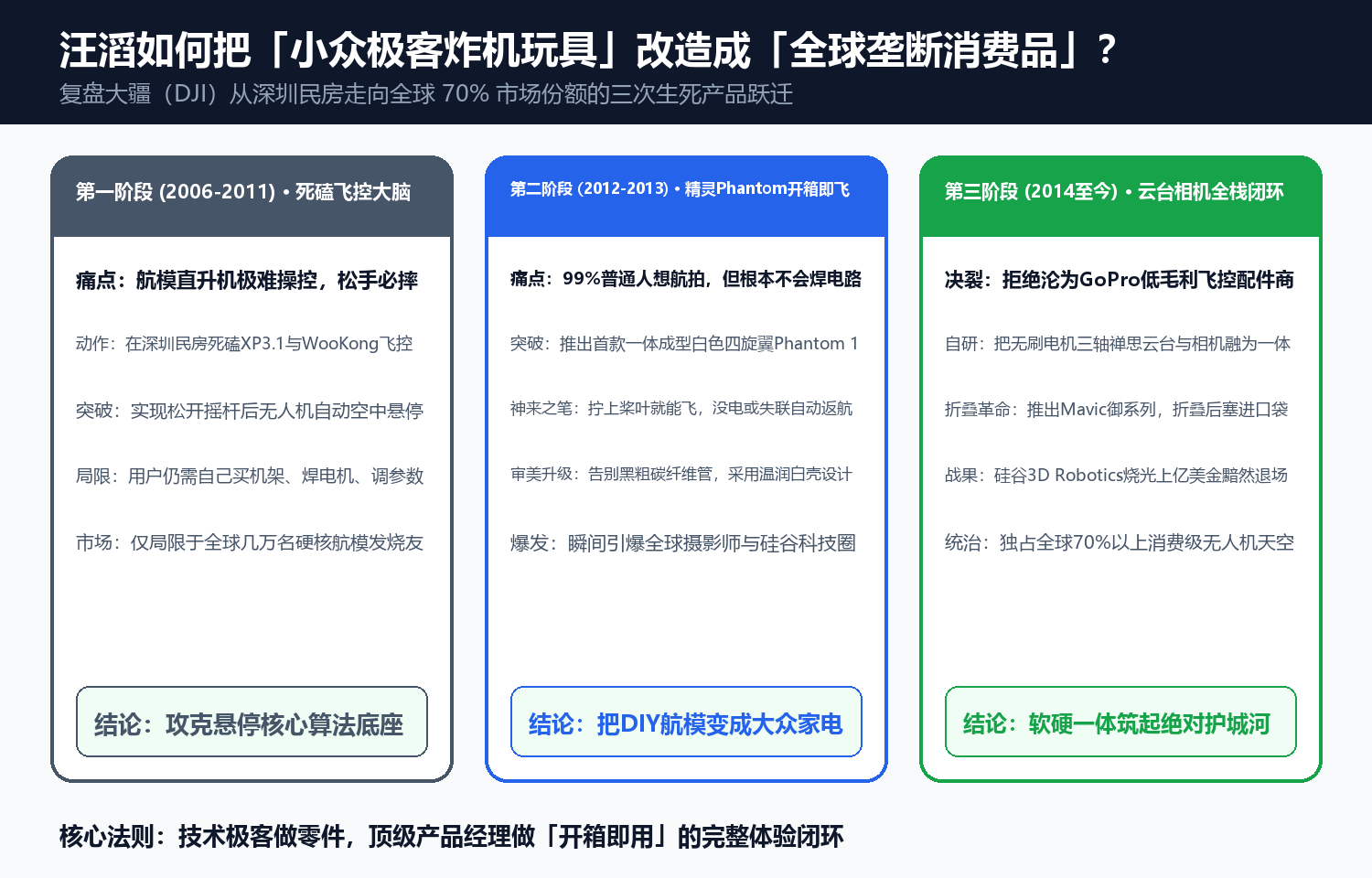
1. Two Dark Years in a Shenzhen Apartment: Everyone Quit, Yet He Kept Obsessing Over Hovering
To understand Wang’s product obsession, you have to understand how brutal RC helicopters were before 2006.
Growing up in Hangzhou, Wang fell in love with aviation after reading a childhood comic about a red miniature helicopter. At 16, his father rewarded his exam scores with an expensive imported RC helicopter. On its very first flight, within three seconds of takeoff, the helicopter spun out of control, crashed into wreckage, and sliced Wang’s hand.
Traditional single-rotor RC helicopters are aerodynamically unstable. Keeping one stationary in the air required a pilot’s thumbs to make a dozen micro-corrections every second. Even seasoned hobbyists watched thousands of dollars shatter on the pavement whenever a crosswind hit.
In 2006, mentored and backed by HKUST Professor Li Zexiang, Wang moved into a tiny Shenzhen apartment with two classmates. The early days were brutal:
- The living room was both assembly workshop and dorm, littered with carbon-fiber tubes, soldering irons, and gyroscopes;
- With no brand recognition and Wang’s notoriously uncompromising temper over product quality, nearly every early employee quit within two years—at one point leaving just Wang and a single administrative bookkeeper.
Yet inside that apartment, Wang cracked the multi-sensor fusion algorithms needed for rock-solid autonomous hovering. When DJI demonstrated its XP3.1 flight controller at international hobby expos—tossing the radio transmitter onto the ground while the helicopter stayed pinned in mid-air against the wind—orders poured in from around the globe, even at ¥20,000 ($3,000) per controller.
2. The 100x Leap: Killing DIY Soldering with the Ready-to-Fly DJI Phantom
Had Wang remained content selling high-margin flight-controller boxes to hardcore hobbyists, DJI would have stayed a niche component vendor.
The decision that vaulted him into the pantheon of product builders came in late 2012.
Multi-rotor quadcopters were emerging, but flying one required an absurd ordeal:
- You had to separately buy a carbon-fiber frame, four brushless motors, four electronic speed controllers (ESCs), a flight controller board, a radio receiver, and a LiPo battery;
- You had to solder the wiring harness yourself at home and tune complex PID control parameters on a PC;
- Nine out of ten beginners crashed on their maiden flight.
Wang looked at the market and saw a ten-billion-dollar truth:
“There are barely 100,000 people on earth who enjoy soldering circuit boards on weekends—but there are tens of millions of photographers and everyday creators who want to put a camera in the sky.”
In January 2013, DJI launched the DJI Phantom 1 (#52 on our 100 Greatest Products list). Wang made three radical product cuts:
- Cut #1 (Zero assembly): The world’s first mass-market Ready-to-Fly (RTF) quadcopter. Screw on four propellers in 60 seconds, press power, and fly.
- Cut #2 (Zero crash panic): Built-in GPS and compass meant if you let go of the sticks, the drone froze in place in mid-air; if signal dropped or the battery ran low, Return-to-Home flew it back to its takeoff spot automatically.
- Cut #3 (Industrial beauty): Instead of exposed black carbon rods and tangled wires that looked like a menacing mechanical spider, Wang insisted on a sleek, Apple-like white molded shell.
At $679, the Phantom turned aerial photography from a Hollywood helicopter line item into a weekend consumer hobby, multiplying DJI’s addressable market a hundredfold overnight.
3. Refusing to Be GoPro’s Subcontractor: The Zenmuse Gimbal Checkmate
When the original Phantom took off, it didn’t have its own camera—users strapped a GoPro to its belly.
Seeing the explosion in aerial video, GoPro approached DJI for an official partnership. But the American giant demanded 2/3 of the profits and wanted its brand front and center, treating DJI as a low-margin contract manufacturer of “flying tripods.”
Most hardware founders would have signed. Wang walked away from the table and gave his engineering team a mandate: build our own cameras and integrate them directly into our proprietary three-axis brushless gimbal.
That became DJI’s second unassailable moat—the Zenmuse gimbal and Lightbridge digital transmission system:
- Coupling direct-drive brushless motors with inertial sensors, the gimbal compensated for wind vibration within milliseconds, delivering butter-smooth aerial footage without post-production stabilization;
- By integrating the camera, gimbal, flight controller, and long-range HD video link into one unified system on the Phantom 3—and then folding the entire package down to the size of a water bottle with the Mavic Pro in 2016—DJI left GoPro’s ill-fated Karma drone and Silicon Valley’s 3D Robotics with no room to breathe.
4. Three Product Laws from an 86-OVR Hardware Master
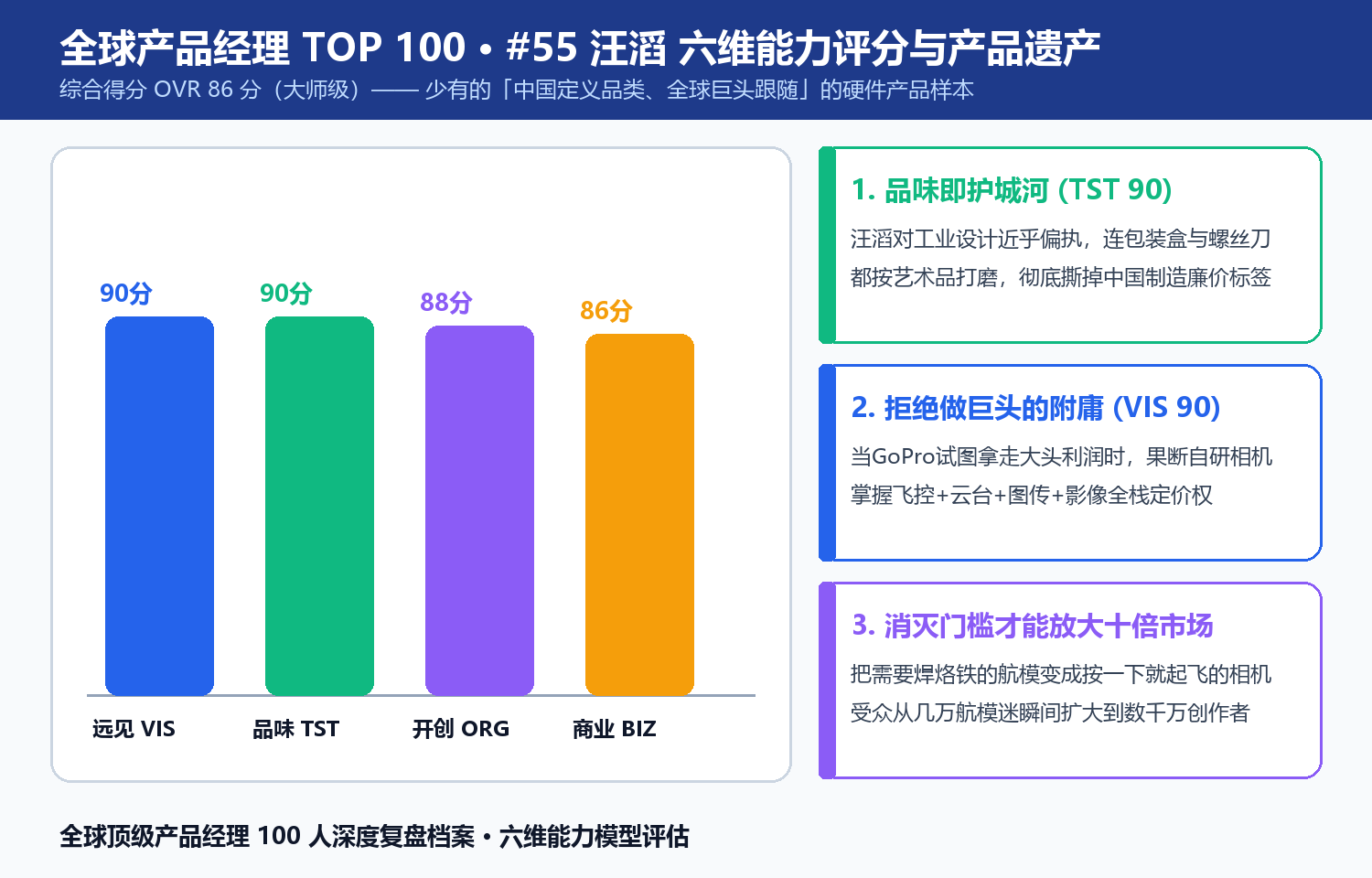
Scoring VIS 90 / INS 84 / TST 90 / BIZ 86 / SCL 80 / ORG 88 (86 OVR) on our Top 100 Product Managers leaderboard, Frank Wang leaves every AI and hardware builder with three enduring lessons:
- Never ask mainstream users to solder your product together: Geeks love configurable parts; 100x product managers hide the complexity inside a box that works on the first press.
- Taste is a hard competitive moat: Wang’s famous obsession with industrial design, packaging, and tactile damping proved that global consumers will gladly pay a premium when engineering is paired with art-grade taste.
- Own the full experience loop: Never outsource the core links that determine whether your user succeeds.
Discussion