Memorizing History Dates for 2 Hours Only to Mix Everything Up? How I Guided a 12-Year-Old to Build an 'AI Dual-Track World History Sandbox' in 60 Minutes
If you have a child in upper elementary or middle school (ages 10–16), you have probably witnessed the Sunday night misery of rote history memorization: two hours spent highlighting dates, emperors, and treaties—only for the child to mix up dynasties the moment the textbook closes, and have zero clue what was happening in Rome or Britain while the Han or Qing Dynasty ruled China.
In Issue #06 of our Kids AI Creator Tutor column, I’ll walk through a 60-minute weekend session with a 12-year-old 7th grader (“Duoduo”), showing how we replaced rote memorization by building an interactive AI Dual-Track World History Timeline & Cause-and-Effect Sandbox.

1. Why the Brain Hates Isolated Dates but Loves Spatial-Temporal Cause Chains
Cognitive psychology shows that the hippocampus struggles to retain disconnected numbers (221 BC, 618 AD), yet effortlessly remembers causal stories (“Crisis → Policy Response → Unintended Consequence”) and parallel spatial coordinates.
| Learning Method | Mental Structure Built | Retention After 7 Days | Performance on Analytical Exam Prompts |
|---|---|---|---|
| 1. Rote Highlighting & Recitation | Isolated 1D fragments of dates and buzzwords | < 25% | Collapses when questions rephrase the context |
| 2. Multiple-Choice Drilling | Shallow keyword matching without causal depth | ~40% | Fails cross-era & China-vs-World comparison essays |
| 3. Building an AI History Sandbox | Horizontal global sync + Vertical causal dominoes | 90%+ | Sees the entire historical chessboard at a glance |
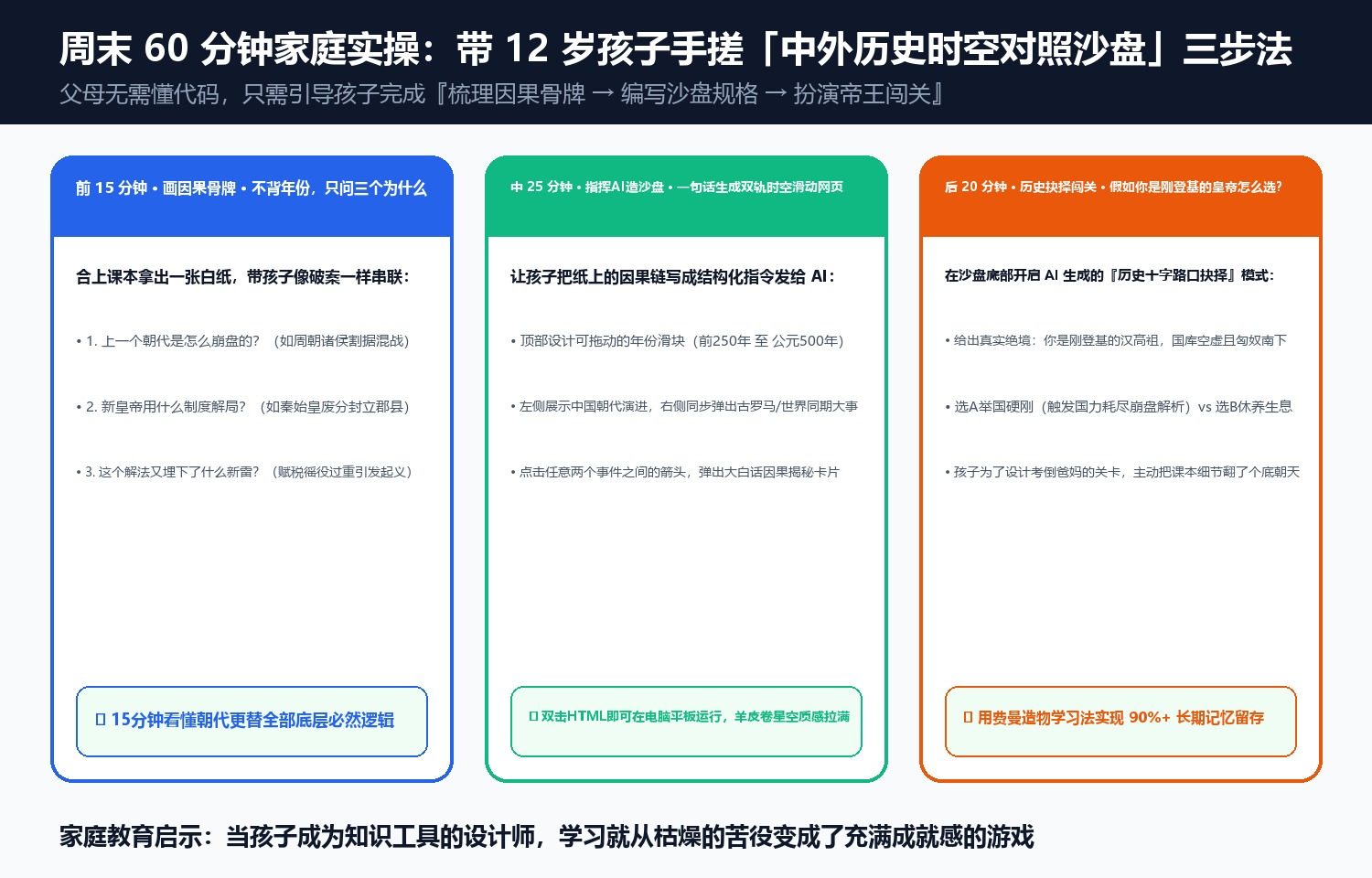
2. The 60-Minute Build: From Textbook Drudgery to Interactive Sandbox
- Minutes 0–15 (Causal Domino Sketching): Instead of memorizing dates, Duoduo mapped each dynasty as a chain of “What crisis did the previous ruler leave behind → What system was invented to fix it → What new problem did that system create?”
- Minutes 15–40 (Prompting the Dual-Track Web App): She instructed AI to generate a single-file HTML/JS application featuring a draggable time slider (
250 BC to 500 AD) that simultaneously displays Chinese historical milestones on the left, synchronous Roman/European events on the right, and an interactive “If You Were the Emperor” policy decision game at the bottom. - Minutes 40–60 (Testing & Iterating): Sliding to
221 BCshowed Qin Shi Huang unifying China alongside Hannibal preparing to cross the Alps in the Second Punic War; sliding to105 ADpaired Cai Lun’s papermaking with Trajan’s Rome. Two weeks later, she scored 98/100 on her history midterm.
💡 Zhitong’s Kids AI Creator Tutor Program (Ages 10–16) Explore more 60-minute family AI project guides at
doaipm.com/en/tutor/or book 1-on-1 in-home AI product & coding tutoring in Hangzhou (¥1,000/hour, ages 10–16).
Discussion