Why I Refuse to Teach AI Coding to Kids Under 10: The Golden Age Redline and a 60-Minute Solar System Simulator Build
Last week, after opening slots for my 1-on-1 in-person Youth AI Creator tutoring in Hangzhou, three mothers sent me almost identical messages:
“Can you teach my 7.5-year-old second grader how to build apps with AI? Commercial coding franchises say kids can start at age 6, and we are happy to pay your hourly rate.”
I politely turned down all three and pointed to the very first rule of my practice: I strictly tutor youths aged 10 to 16 (Grades 4 through High School). I never accept children under 10.
Why turn away paying clients when commercial coding chains aggressively market to kindergartners? Today, let’s examine the cognitive science behind the Age 10 Redline, followed by a full walkthrough of how an 11-year-old fifth grader built an interactive Newtonian Solar System Gravity & Asteroid Impact Simulator in 60 minutes.
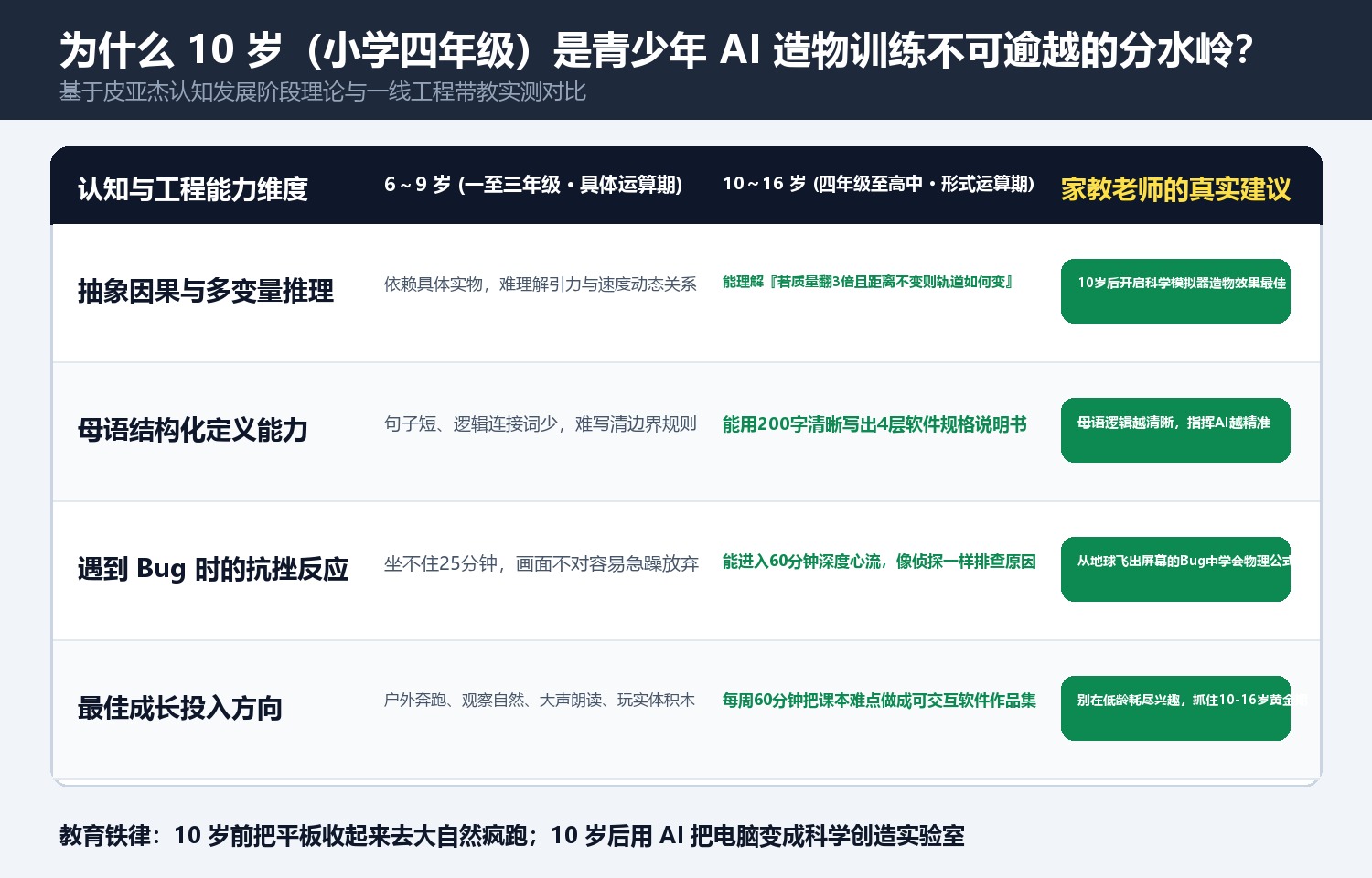
1. Why I Strictly Refuse Kids Under 10 (Three Hard Truths)
Commercial kids’ coding franchises push “coding for 6-year-olds” for one business reason: to maximize multi-year tuition renewals. Yet in developmental psychology and real-world software engineering, age 10 is a fundamental biological and cognitive threshold:
| Cognitive Dimension | Ages 6–9 (Grades 1–3 · Concrete Operational) | Ages 10–16 (Grade 4–High School · Formal Operational) | Risk of Premature AI Exposure (< Age 10) |
|---|---|---|---|
| Piaget’s Developmental Stage | Bound to tangible objects; struggles with multi-variable abstraction and counterfactual causality | Formal Operational explosion: grasps hypothetico-deductive logic (if mass triples while radius stays constant, how does orbit change?) | Treats AI as a passive “magic vending machine” without understanding underlying rules |
| Structured Native-Language Expression | Still building basic vocabulary and causal connectives | Capable of articulating a 200-word structured specification with clear states and edge cases | In the AI era, clear native language is the ultimate programming language |
| Debugging Resilience | Short attention span (<25 mins); easily frustrated by unexpected outputs | Can sustain a 60-minute deep Flow state, diagnosing bugs like a detective | Over-reliance on instant AI answers erodes independent problem-solving patience |
2. Inside a 60-Minute Session: Building a Newtonian Solar System Simulator with an 11-Year-Old
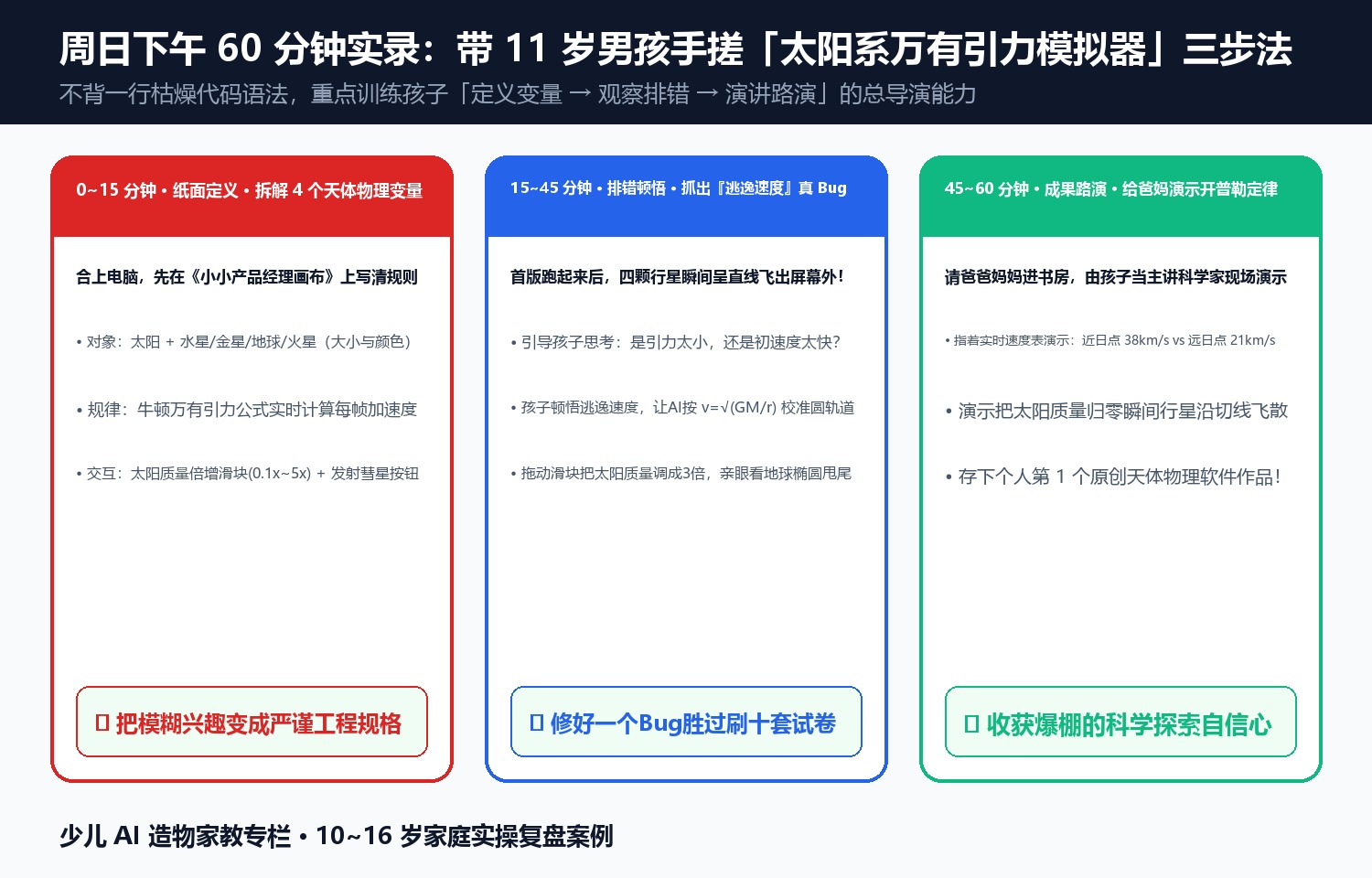
This past Sunday, I worked with Chenchen, an 11-year-old fifth grader fascinated by astronomy who struggled to visualize orbital mechanics on school science tests. Here is how we spent our 60 minutes:
- Minutes 0–15 (Define on Paper): Using the Junior Product Manager Canvas, Chenchen defined four core specs: the celestial bodies (Sun + 4 inner planets), the true Newtonian inverse-square gravity formula ($F = G m_1 m_2 / r^2$), three interactive controls (Solar Mass slider
0.1x–5x, Time Warp slider, and a “Launch Rogue Asteroid” button), and orbital trails with live velocity readouts (km/s). - Minutes 15–45 (Develop & Debug a Real Physics Bug): In v1, all four planets immediately flew off the screen in straight lines! Instead of panicking, Chenchen realized their initial velocity exceeded solar escape velocity. He instructed the AI to calculate exact circular orbital velocity ($v = \sqrt{GM/r}$) and added preset buttons for
+20% Elliptical Orbitand+50% Escape Velocity. - Minutes 45–60 (Validate & Demo to Parents): Chenchen invited his parents in and demonstrated Kepler’s Second Law live on screen by showing how Earth accelerated to
38 km/sat perihelion and slowed to21 km/sat aphelion when he doubled the Sun’s mass.
💡 About Zhitong’s Youth AI Creator Column & In-Person Tutoring: I am Zhitong (founder of
doaipm.comand solo creator of 13 shipped software products). Alongside sharing daily hands-on family AI tutorials here, I offer 1-on-1 In-Person Youth AI Creator Private Tutoring in Hangzhou (¥1,000 / hour, strictly ages 10–16). Learn more at doaipm.com/en/tutor/.
Discussion