TAG

# tech commentary

← All tags · 44 post(s)

2026-08-09

How Expensive Can One Product Judgment Get? Zuckerberg Renamed the Company Meta for the Metaverse, Burned $80 Billion in Four Years, and Is Now Cutting the Budget

In 2025 Reality Labs booked $2.21 billion in revenue and a $19.19 billion operating loss — it lost $8.70 for every dollar it took in. That was the fourth full year after Zuckerberg renamed Facebook to Meta on October 28, 2021, and the fifth straight year the loss curve widened, with not one year of narrowing in between. Bloomberg reported in December 2025 that Meta's 2026 budget would cut the metaverse division by up to 30%, while every other department was asked to find 10%. The savings went to AI glasses. One line in the original rename announcement usually gets skipped: the ticker was to change from FB to MVRS on December 1 — a symbol that never traded a single day, because what actually listed on June 9, 2022 was META. He ranks 9th on our board with an OVR of 95: scale 99, insight 96, and a vision score of 94, the lowest in the top ten. This piece is about the bill product managers habitually underestimate: the cost of retreat depends on which layer you bound the judgment to.

How Expensive Can One Product Judgment Get? Zuckerberg Renamed the Company Meta for the Metaverse, Burned $80 Billion in Four Years, and Is Now Cutting the Budget
2026-08-08

Your Hardware Just Shipped a Serious Defect — Now What? The GAC Toyota bZ7 Was Recalled Twice in Under 100 Days, Both Times for Software

On August 1, GAC Toyota filed two recalls for the bZ7: S2026M0083V covering 15,266 vehicles and S2026M0084V covering 24,286, for 39,552 in total. Both notices name software as the defect — one says the smart Bluetooth module's software control program was insufficiently considered, which can shift the car from D to N while driving; the other says the thermal management controller's software strategy is incomplete, which can kill defrost and defog. Both are fixed over the air, with no service visit. The same month brought three recalls that require hands: Land Rover pulls 160,232 vehicles from August 8 for fretting corrosion at the airbag connector, fixed by greasing terminals one car at a time, and XPeng pulls 33,473 X9s from August 28 to replace air spring struts. This piece is about the two faces of one shift: software has crushed the cost of the fix to almost nothing, and has not removed a single filing obligation.


Your Hardware Just Shipped a Serious Defect — Now What? The GAC Toyota bZ7 Was Recalled Twice in Under 100 Days, Both Times for Software
2026-08-07

Is a PM's Record Measured by the Exit or by Survival? Musk's X Product Head Sold Two Hits — Both Were Shut Down

On August 5, Nikita Bier stepped down as head of product at X, a year and one month after taking the job in July 2025. His farewell line: it's time to pass the torch and demote myself to my natural state, a poster. His record before that was solid — tbh sold to Facebook in 2017, Gas sold to Discord in 2023, two clean exits. But TechCrunch put it plainly: both apps were later shut down. In his year at X he says he shipped 30 new products, rebuilt the feed, the Android app, DMs and notifications, and finally landed X Money, which Musk had promised back in 2024. A man whose definition of success is the exit walked into a company that can't be sold. This piece asks whether that playbook holds up, and how a product manager's résumé should actually be scored.

Is a PM's Record Measured by the Exit or by Survival? Musk's X Product Head Sold Two Hits — Both Were Shut Down
2026-08-06

AlphaGo's Demis Hassabis Steps Back From Running DeepMind Day-to-Day — and Google's Chief Scientist Walks Out the Same Day With Three Others

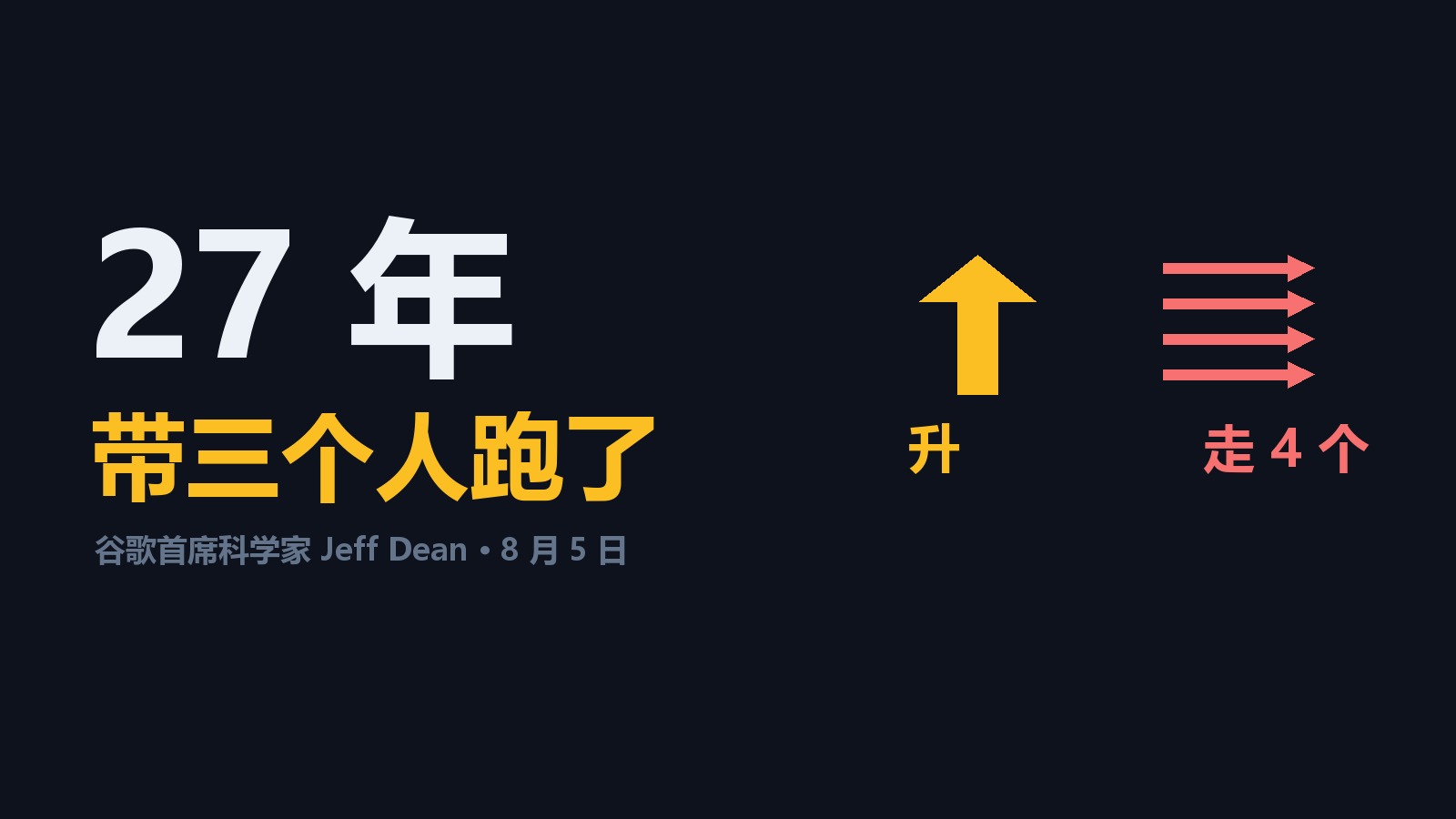
On August 5 Google announced that Demis Hassabis is becoming chair of Google DeepMind and handing off day-to-day operations. Alphabet fell more than 5%. Everyone talked about that. The same day carried another item almost nobody looked at closely: Jeff Dean, Google's chief scientist and 27-year veteran, left to start a company — taking Sanjay Ghemawat, Quoc Le and Oriol Vinyals with him. Sanjay's name means little to most readers, yet he and Dean are the only two level 11 Senior Fellows Google has had in twenty-odd years, and they spent those years writing code hunched over the same computer. What Dean built in 27 years was all foundation: search index scaled 100×, Google's first ads system, MapReduce, BigTable, Spanner, TensorFlow, the TPU program. That operating system assumes you have time to build foundations — and Google just moved the clock forward. Stranger still: Google didn't push him out. It invested in his new company and wants to sell him cloud.

AlphaGo's Demis Hassabis Steps Back From Running DeepMind Day-to-Day — and Google's Chief Scientist Walks Out the Same Day With Three Others
2026-08-05

Why Is Google Guaranteeing $43.8B of Other People's Data Center Rent? TPU Operators Borrow at 7.1%, Nvidia's at 9.3%

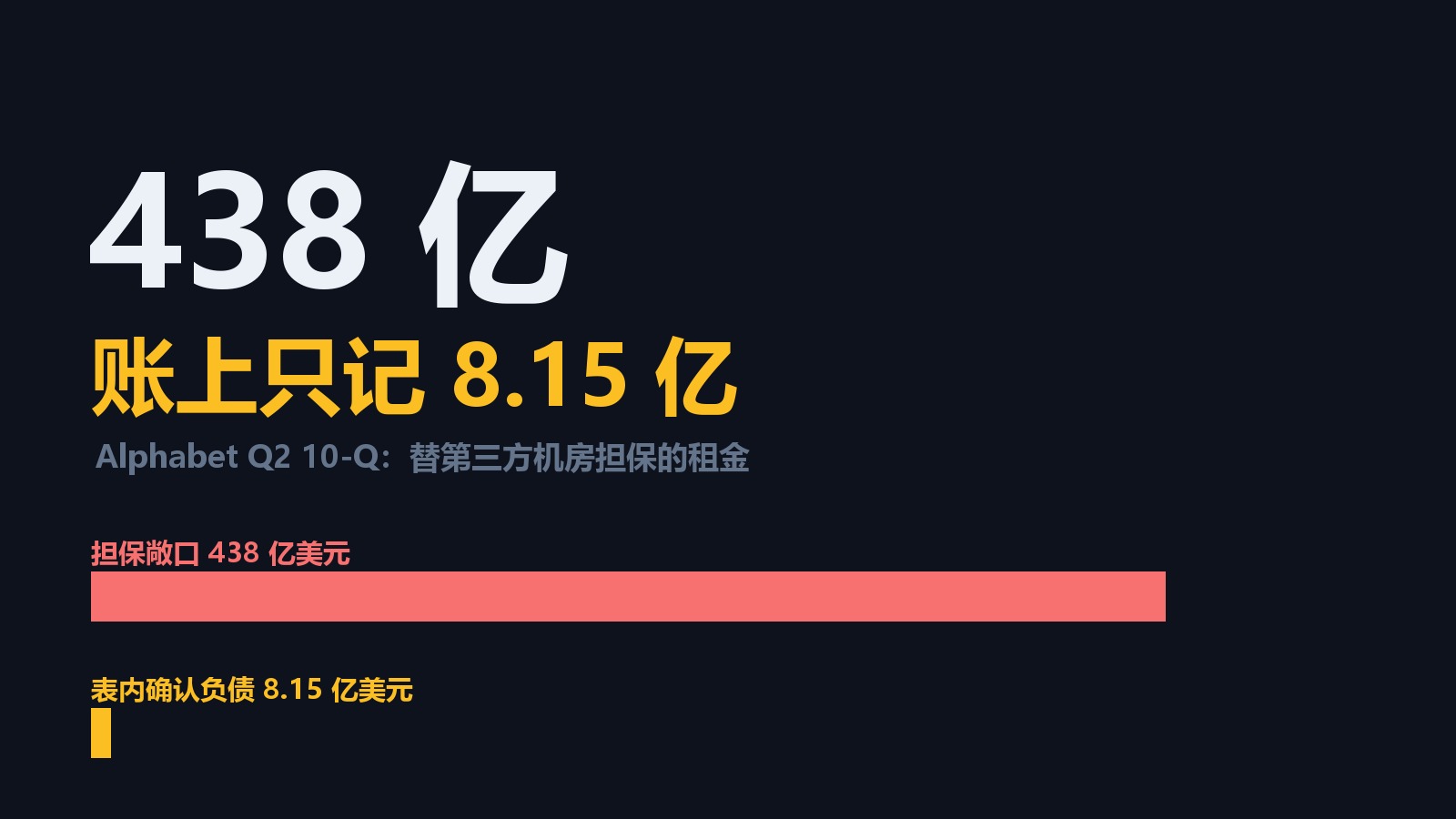
There's a number in Alphabet's Q2 2026 10-Q: as of June 30, Google had committed to cover up to $43.8 billion in third-party data center lease payments if tenants default. Nine months earlier that figure was $6.5 billion — a sevenfold increase. None of those data centers are Google's. What the guarantee buys is very concrete: with Alphabet standing behind them, operators running Google TPUs borrow at 7.1% while comparable projects in Nvidia's ecosystem pay 9.3% — a structural 2.2-point gap. At the other end of the chain sits Anthropic: run-rate revenue just past $30 billion, up from about $9 billion at the end of 2025, but with no credit rating and no way to borrow at this scale on its own. In between stand Morgan Stanley's Compute SPV, Broadcom as residual-value guarantor, and crypto miners supplying grid power. This piece takes apart how the machine works, why Google would rather keep $43.8B of exposure off its balance sheet, and the path the risk travels back.

Why Is Google Guaranteeing $43.8B of Other People's Data Center Rent? TPU Operators Borrow at 7.1%, Nvidia's at 9.3%
2026-08-04

Should You Still Build an MVP in the AI Era? 211M Lines of Code Say Rework Went From 3.3% to 7.1%

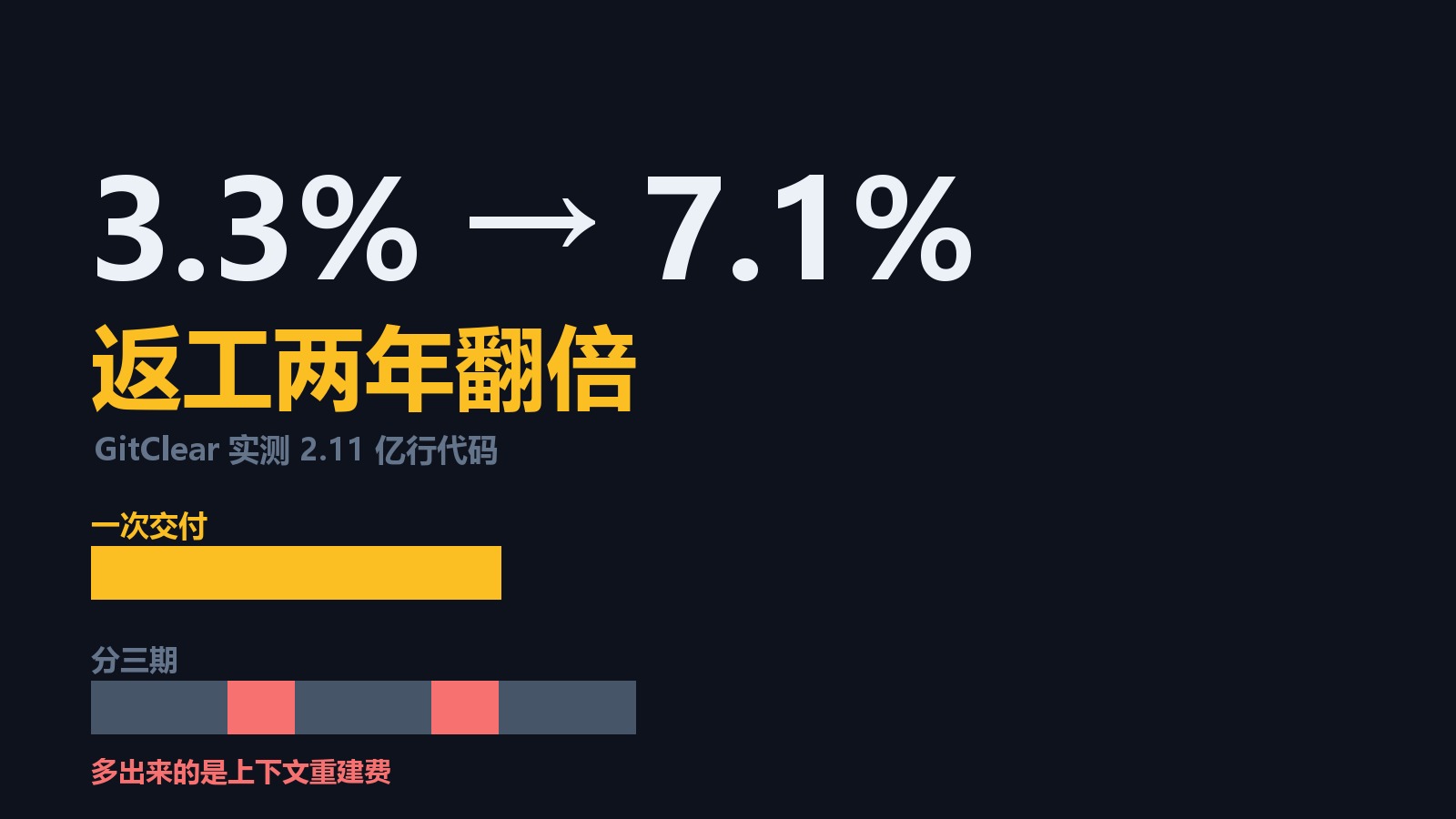
Should you still start with an MVP, still ship in phases? Throw an idea at an AI and eight times out of ten it opens with let's build a minimum viable version — and that suggestion is memorized from its training data, not calculated. The Agile Manifesto is from 2001, The Lean Startup from 2011, and the methodology rests on one premise: that a crude implementation costs far less than a complete one. With AI that premise is gone. Telling Cursor to store it in localStorage and telling it to use PostgreSQL with a connection pool differ by minutes. Worse, the AI's bill is structured backwards from a human's: most input tokens are context, not the task, and two retries can triple the cost of a session. GitClear's analysis of 211 million lines found that code rewritten or deleted within days of merging has climbed from 3.3% to 7.1%. This piece takes apart why iteration was designed for human cost structures, and where doing it right once differs from doing it all at once.

Should You Still Build an MVP in the AI Era? 211M Lines of Code Say Rework Went From 3.3% to 7.1%
2026-08-03

AI's Standard Isn't in the Model. It's in the Last Version You Nodded At

Once you compromise a single time, AI lowers the bar, then keeps compromising, and ends up producing garbage — that observation is correct. The reason isn't that the model isn't smart enough. It's that a standard doesn't exist inside the model at all; it exists in the context. The most recent sample in the context is the standard, and every one of your fine, ship it moments is calibrating it. This piece uses my own concrete failures from three days to take the mechanism apart: a cover that cropped $45 billion down to $5 billion, a paragraph added purely to hit a word count, three straight days of believing a success report that was wrong. It also explains why written rules fail the same way — the number of rules is a counter of failures, and it only covers the failure modes you already thought of.

AI's Standard Isn't in the Model. It's in the Last Version You Nodded At
2026-08-03

Apple Put a Quota on Bug Reports — and 11 Flaws in the Same Patch Batch Were Found by AI

On August 2 the Financial Times reported that Apple has capped how many security reports a researcher can keep open at once and added a 30-day cool-off period, citing a flood of AI-assisted submissions. One week earlier, on July 27, Apple shipped 8 security advisories fixing 210 vulnerabilities — and 11 of them were found by AI: four credited to Claude, two to OpenAI Codex Security, three to the NVIDIA AI Red Team, two to Z.AI's GLM, and one screen-sharing privilege escalation to an automated engine called Atuin. The same day, GitHub halved its public bounty tiers and moved top payouts into an invite-only track. curl took the third road — leave the door open, remove the money — and reopened this morning after five weeks shut. Three projects, three different parts of the machine: one changed the incentive, one changed reputation, one changed the gate.

Apple Put a Quota on Bug Reports — and 11 Flaws in the Same Patch Batch Were Found by AI
2026-08-02

Tim Cook's Last Quarter: Apple Got Caught by Its Own Demand Forecast

On July 30, Tim Cook hosted the last earnings call of his tenure. He warned that iPhone, iPad and Mac will all be supply-constrained in the September quarter, and that Apple has less flexibility in the supply chain than normal, with a shortfall in leading-edge capacity. But he also named the root cause: this is not a supply issue but a demand forecast issue — demand ran beyond Apple's expectation. DRAM and NAND are up 63%–75% year over year, Cook called memory pricing a hundred-year flood, and admitted Apple did not want to raise prices but had to. John Ternus becomes CEO on September 1. A man who spent 25 years running supply chains ends his last quarter stuck on supply — and the root cause is a product judgment.

Tim Cook's Last Quarter: Apple Got Caught by Its Own Demand Forecast
2026-08-01

On July 24 He Called It a 'Strategic Entry Window.' On July 30 the Fund Was Force-Liquidated.

Leopold Aschenbrenner was born in 2001, fired by OpenAI at 22, published Situational Awareness in June 2024, and launched a fund under that name in September 2024, long AI infrastructure. By early July 2026 the fund ran $45 billion, up more than 2000% cumulatively and 439% in the first half of 2026 alone. On July 24 he wrote to investors calling the drawdown a "strategic entry window" and invited them to add capital on August 1. On July 30 the fund was force-liquidated: Citadel took the entire public-market book, about $16 billion, at a discount in under 36 hours. July losses: 67%. The next day the stocks he was liquidated out of rose 25.99%, 21.51%, and 26.49%. This is a breakdown of why what he was long got repriced on exactly July 30, and how a correct long-term call turns into a wrong position under 4x leverage.

On July 24 He Called It a 'Strategic Entry Window.' On July 30 the Fund Was Force-Liquidated.
2026-07-31

Same Day: Microsoft Added $450 Billion in Market Cap, Meta's Free Cash Flow Fell to $784 Million

On July 30, Microsoft rose 15.63% and added roughly $450 billion in market value in a single day, the largest one-day gain in US market history, past Nvidia's $441 billion on April 9, 2025. Meta fell 9% the same day. Both had reported the night before, both grew revenue, and Meta grew faster. The difference was somewhere else: Microsoft cut its calendar 2026 capex guidance from the roughly $190 billion it gave in April to about $175 billion, while Azure growth accelerated from 40% to 43%. Meta raised its full-year capex guidance to $130–145 billion and reported $784 million in free cash flow. This piece breaks down where that $15 billion came from, which part is efficiency and which part is accounting treatment, and what it means for product managers that Microsoft holds 27% of OpenAI and also put $5 billion into Anthropic.

Same Day: Microsoft Added $450 Billion in Market Cap, Meta's Free Cash Flow Fell to $784 Million
2026-07-30

He Gave Away 2.8 Trillion Parameters, Then Left One Gate in the License — Yang Zhilin, and Why He Still Isn't on This List

On July 27, Moonshot AI uploaded the complete weights of Kimi K3 to Hugging Face. 1.42 TiB, 2.8 trillion total parameters, 104 billion active, a 1-million-token context window — the largest open-weight model ever released. The part a product manager should read isn't the parameter count, it's clause two of the license: the body of it looks like MIT, but the moment you turn it into a service and clear $20 million a year, you come back and sign a separate agreement with Moonshot. Rarer still, in their own release materials they concede that K3's overall performance still trails Claude Fable 5 and GPT-5.6 Sol, and that the user experience has a gap. The same week, the White House CTO publicly accused them of distilling Anthropic. This piece is about three of Yang Zhilin's product decisions, and it answers one question head-on: why he isn't in The 100 Product Managers Who Changed the World.

He Gave Away 2.8 Trillion Parameters, Then Left One Gate in the License — Yang Zhilin, and Why He Still Isn't on This List
2026-07-28

CXMT Jumped 466% on Day One. The Company Has No Product Manager

On July 27, 2026, ChangXin Memory listed on the STAR Market and closed up 465.82% at a 3.28 trillion yuan valuation, raising 57.9 billion yuan — the largest IPO in STAR Market history. Three years ago it lost 16.7 billion; cumulative losses hit 36.65 billion. This year it made 24.7 billion in a single quarter. DRAM specs are written by JEDEC and prices are set by the cycle. In twenty years, not one of Zhu Yiming's key decisions was a product decision.

CXMT Jumped 466% on Day One. The Company Has No Product Manager
2026-07-28

The 100 Product Managers Who Changed the World · No. 6 | Elon Musk: He Tore Out a Production Line That Was Making Money, to Make Room for a Robot That Can't Stand Up on Its Own

Tesla reported Q2 on July 22: revenue up 26%, operating income down 57%. The part that fell wasn't taken away by the market — he spent it himself. Inside Fremont, the Model S and Model X lines were torn out to make room for Optimus's first production line, and "other models" production dropped 34% year over year. The same week, in a 90-minute interview with The Economist, he said AI may exceed the sum of human intelligence within five years; on the earnings call he said everyone else's humanoid robots are "teleoperation and scripts." No. 6 on the list, OVR 95: vision 99, originality 99 — then insight 88 and taste 84. This piece is about those two docked scores. They aren't a knock on him; they're the same key that explains why he dared tear out that line, and why Waymo has pulled away from him on Robotaxi.

The 100 Product Managers Who Changed the World · No. 6 | Elon Musk: He Tore Out a Production Line That Was Making Money, to Make Room for a Robot That Can't Stand Up on Its Own
2026-07-26

The TIME Cover Shows a $650,000 Mecha. Wang Xingxing's Best Seller Costs Under $5,000

On July 23, Wang Xingxing and the GD01 manned mecha landed on the cover of TIME. But inside the issue sits a different set of numbers, and those are the ones product people should read: robot dogs down from $45,000 to under $2,000 in six years, the R1 under $5,000 — and 74% of shipments going to universities and labs. The product he is really pushing is the price curve.

The TIME Cover Shows a $650,000 Mecha. Wang Xingxing's Best Seller Costs Under $5,000
2026-07-22

This Round of Big Tech Layoffs Is Hunting the Product Managers Who Just Pass Messages Along

As of July, the tech industry has cut roughly 200,000 jobs in 2026 — a thousand a day — and more than half the layoff notices name-check AI. The strangest data point is Microsoft: on the same day it cut 4,800 people, HR chief Amy Coleman went out of her way to add, 'The roles eliminated today were not replaced by AI.' Everyone else is racing to say 'AI did it'; Microsoft is racing to say 'don't blame AI.' Underneath those two contradicting statements is the same answer nobody wants to say out loud: the first thing AI eats isn't a job title, it's a layer — the message-passing layer. And product managers happen to be one of the most message-dense roles there is.

This Round of Big Tech Layoffs Is Hunting the Product Managers Who Just Pass Messages Along
2026-07-21

The 100 PMs Who Changed the World · No. 13 | Jensen Huang: The Most Expensive Company on Earth — Stuck Outside the Pantheon of Product Managers

No. 13 on the list is Jensen Huang, OVR 94, stuck one full point outside the Pantheon (the 95 line). Just this month, OpenAI's GPT-5.6, xAI's Grok 4.5, Moonshot's Kimi K3, and Meta's Muse Spark took turns dropping new models to grab headlines — but they all run on Jensen Huang's chips. Nobody knows who wins the model war; the man selling the shovels wins for sure. His NVIDIA soared to a $5.4 trillion market cap, the most valuable company on this planet. And yet a man standing at the very core of the AI era can't get into the Pantheon on this product-manager list, ranking only in the Legends tier. The answer hides in the two lowest of his six dimensions: Taste 83, Insight 87. This isn't a knock on him — it's precisely the key to understanding him. He's the most profitable kind of product manager of this era, and that kind of product manager doesn't run on taste.

The 100 PMs Who Changed the World · No. 13 | Jensen Huang: The Most Expensive Company on Earth — Stuck Outside the Pantheon of Product Managers
2026-07-20

Spain Beat Argentina 1-0 and Lifted the Cup, Messi Bowed Out With 0 Shots: What Locked Down the World's Best Was a System

July 19, New York. Spain beat Argentina 1-0 with an extra-time winner and lifted the World Cup trophy. And Messi — in the final of the last World Cup of his career — played the full match with a shot count of 0. In 120 minutes Argentina took just 2 shots, 0 on target, shut down completely. To make the player the whole planet agrees is the best go a full night without a single shot, one defender is never enough — it takes an entire team, an entire system: Rodri locking down midfield, ~70% possession keeping Messi out of dangerous areas, 20 shots to 2. Put another way: Spain didn't beat Argentina by finding a stronger genius; they used a system that depends on no single person to lock down the single strongest person. This final quietly taught a lesson to everyone who builds products and leads teams.

Spain Beat Argentina 1-0 and Lifted the Cup, Messi Bowed Out With 0 Shots: What Locked Down the World's Best Was a System
2026-07-19

The Woman Who Built ChatGPT Just Shipped a Model She Admits Isn't the Strongest — and Investors Are About to Value Her at $50 Billion

Yesterday Kimi K3 was still shouting "topped the charts, number one in the world." Today the woman who built ChatGPT did the exact opposite. On July 16, Mira Murati's Thinking Machines released Inkling — a 975B open-weights model, natively multimodal, with adjustable thinking effort — yet in black and white the announcement says it is "not the strongest overall model available today, open or closed." Meanwhile this company, just a year and a half old, is raising a new round at roughly a $50 billion valuation — four times last July's. Why is someone who shipped a model that isn't the strongest worth $50 billion? The answer hides in the thing she's best at, and the most expensive thing in the AI era: judging what actually makes a good product.

The Woman Who Built ChatGPT Just Shipped a Model She Admits Isn't the Strongest — and Investors Are About to Value Her at $50 Billion
2026-07-18

The 100 PMs Who Changed the World · No. 3 | Jeff Bezos: At 62 He Made Himself CEO Again — to Bet on the One Thing Amazon Never Pulled Off

No. 3 on the list is Jeff Bezos, OVR 97, with a 99 on the Business dimension — the highest tier on the whole list, higher even than Jobs. Just last month, this man — retired four years, worth roughly $250 billion, free to spend his days on rockets and yachts — made himself CEO again: personally co-leading the AI startup Project Prometheus, which just raised $1.2 billion in June at a $41 billion valuation. Why would a man who perfected the art of "letting go," who designed his company to run without him, step back into the ring at 62? The answer hides in his real invention — a method that forces everyone to first write down, on six pages, exactly what they want, and to write the press release before building anything. In today's world, that method happens to be the most valuable thing there is.

The 100 PMs Who Changed the World · No. 3 | Jeff Bezos: At 62 He Made Himself CEO Again — to Bet on the One Thing Amazon Never Pulled Off
2026-07-17

The 100 PMs Who Changed the World · No. 5 | Zhang Yiming: His Best Product Isn't Douyin — It's a Machine That Mass-Produces Hits

No. 5 on the list is Zhang Yiming, OVR 96. Just last month, his net worth of $92.8 billion overtook Ambani, making him the second-richest man in Asia and the undisputed richest in China — and this is a man who almost never gives interviews, stepped down as CEO back in 2021, and rarely even shows his face. How does an "invisible" man become the second-richest in Asia? The answer hides in the lowest of his six dimensions: Taste, just 88. That's not a knock on him — it's precisely the key to understanding him. Because Zhang Yiming is the most counterintuitive product manager on this list: he deliberately refuses taste, replacing intuition with data and aesthetics with algorithms, and built a machine that keeps mass-producing global hits. This piece breaks down his six scores — and a bet that Doubao is now putting back to the test.

The 100 PMs Who Changed the World · No. 5 | Zhang Yiming: His Best Product Isn't Douyin — It's a Machine That Mass-Produces Hits
2026-07-13

Kung Fu Women's Soccer only scored 6.6, yet Stephen Chow is the most ruthless product manager I've ever seen

Kung Fu Women's Soccer opened at 6.6 on Douban, with 8.6% of viewers giving it one star. The comments trash it: cheap effects, try-hard acting, a plot that's just Shaolin Soccer with a gender swap — reheated leftovers. Yet it crossed 100 million in 27 minutes on day one, took 76.8% of screenings, and pulled in 500 million over two days, with total box office forecasts revised up from 1.428 billion to 1.865 billion RMB. A product the professional audience flunked is winning big commercially. That's not luck, and it's not as simple as a bad movie cashing in — the critics and the box office are actually scoring two completely different products. And what makes Stephen Chow such a ruthless product manager is that he knows better than anyone which one he's shipping. This piece takes it apart — and takes apart the price of it too.

Kung Fu Women's Soccer only scored 6.6, yet Stephen Chow is the most ruthless product manager I've ever seen
2026-07-12

A Typhoon That Fizzled Out: How a PM Survives the Darkest Hour Like Riding Out a Storm

Typhoon No. 9, "Bawei," veered south last night, making landfall along the coast from Wenling in Zhejiang down to Xiapu in Fujian. The fishing boats moved overnight out of Zhoushan and Putuo, the cancelled flights — in hindsight it all looks like wasted effort, so people start saying "we didn't need to bother." But those three words, "false alarm," can kill a product manager faster than the typhoon itself. Riding out a storm was never one move; it's three: prepare fully before it arrives, take the wind and rain when it hits, and clean up the mess after it leaves. The day GitLab dropped its database, it discovered none of its five backups actually worked. Knight Capital lost $440 million in 45 minutes over one chunk of dead code someone forgot to delete — and the company was gone. This is about what an operator should actually do on the night the alarm truly sounds.

A Typhoon That Fizzled Out: How a PM Survives the Darkest Hour Like Riding Out a Storm
2026-07-11

Why People Insist That Typhoons Steer Clear of Putuoshan

There's a widely repeated claim — Putuoshan is protected by Guanyin, so typhoons always detour around it. Yet today, Typhoon No. 9 (Bavi) shut down Putuoshan's ferries, canceled 14 flights at its airport, and forced every fishing boat in the district to evacuate overnight; back in 2021, In-Fa flooded 6,000 meters of road across the Putuoshan-Zhujiajian area. Putuoshan is no typhoon-proof zone — it's getting hit today. So why do people still believe the Bodhisattva turns typhoons away? That misattribution — crediting mere "survival" to "mysterious protection" — is the exact same cognitive move as worshipping "great PMs as prophets." This piece takes it apart.

Why People Insist That Typhoons Steer Clear of Putuoshan
2026-07-10

The 100 Product Managers Who Changed the World · No. 4 | Sam Altman: His Real Product Was Never ChatGPT — It's OpenAI Itself

No. 4 on the list is Sam Altman, OVR 96 — but the lowest of his six dimensions is taste, just 87. That's not a knock on him; it's the key to understanding him. This week he wasn't busy with product: he admitted to CNBC that OpenAI made "a lot of changes" with the White House to ship GPT-5.6, was reported to have offered a U.S. sovereign fund 5% of the company, and published a pitch for an "American-led international AI forum." A consumer product company's CEO, spending a week on the Treasury Secretary — because the product he's actually running was never that chat box. It's where the three letters O-P-E-N-A-I sit in the world. This piece breaks down his six scores, and the bet the numbers are now testing.

The 100 Product Managers Who Changed the World · No. 4 | Sam Altman: His Real Product Was Never ChatGPT — It's OpenAI Itself
2026-07-09

The 100 Product Managers Who Changed the World · No. 1 | Steve Jobs: The Only 99 on the Entire List Went to a Man Who Never Wrote Code

I had Claude score the 100 product managers who changed the world, and only one 99 came out of the entire list — Steve Jobs. What's interesting is that the two biggest stories of early 2026 both testify to that score: Apple outsourced the rebuilt Siri to Google Gemini, and OpenAI spent $6.4 billion to bring in Jony Ive, with its first device due in the second half of the year. This piece walks through his six dimension scores one by one: why vision earned a 99, why insight lost a point, the tuition hidden inside the 97 for business — and why the greatest product manager in history happened to be a man who never wrote code.

The 100 Product Managers Who Changed the World · No. 1 | Steve Jobs: The Only 99 on the Entire List Went to a Man Who Never Wrote Code
2026-07-08

The 100 Product Managers Who Changed the World · No. 2 | Allen Zhang: Insight and Taste Both 99 — Yet He Chose to Leave Business at 92

No. 2 on the list is Allen Zhang, OVR 97, second only to Steve Jobs. What's fascinating is that across his six dimensions, insight is 99 and taste is 99 — the ceiling of the entire list, shoulder to shoulder with Jobs and even higher — yet business is only 92, the lowest of his six. It's not that he can't make money; the opposite. He deliberately pushes away money handed to him on a plate. The one thing this year that best explains this operating system: Tencent's own AI, Yuanbao, can't catch Doubao on monthly actives — and a rarely-stated reason is that Allen Zhang's WeChat locked even Tencent's own AI outside the social graph. This piece unpacks Zhang across the six dimensions, and unpacks a bet that is being re-validated in the second half of the AI era.

The 100 Product Managers Who Changed the World · No. 2 | Allen Zhang: Insight and Taste Both 99 — Yet He Chose to Leave Business at 92
2026-07-07

The same AI: some companies use it to fire, others to hire

Tech layoffs explicitly blamed on AI have hit over 87,000 people this year. Meta is raising capex up to $145B to build AI infrastructure while cutting ~8,000 jobs — and openly says the cuts are 'to offset other investments we're making,' which translates to: we're laying people off to pay for GPUs. Yet in that same industry, Anthropic has had zero layoffs this year and is growing fast; OpenAI is standing up a $4B deployment company to recruit Forward Deployed Engineers everywhere; Google just posted 59 of the same role. Same AI, one company's excuse to fire, another company's reason to hire. Which means the variable was never the AI. Here's what's actually going on — and what it means for the rest of us.

The same AI: some companies use it to fire, others to hire
2026-06-20

Becoming an AI-Era PM 01 | Which PM Tasks AI Took Over, and Which Ones Got More Valuable

This is the first piece in the series Becoming an AI-Era PM. In 2026, plenty of AI PM job descriptions dropped writing PRDs, drawing prototypes, and building dashboards from the hard requirements, and swapped in three work samples instead. The tasks AI can take over are falling out of the hiring requirements, and what's left as the bar is the part only a person can do. This piece lays the took over and got more valuable columns side by side, as the overview for the whole series.

Becoming an AI-Era PM 01 | Which PM Tasks AI Took Over, and Which Ones Got More Valuable
2026-06-20

The Knicks Won It All. Their 56-Year-Old Coach Never Played a Minute in the NBA. That's the Whole Re-Employment Playbook for the AI Age.

The Knicks won their first championship in 52 years, and the coach holding the trophy, Mike Brown, is 56 and never made a single shot in an NBA game. Pull the camera back across the whole league: the players running the floor are in their twenties, and the people calling the shots from the sideline are all gray-haired, fifty to seventy-something. Players sell their legs; coaches sell their judgment — and those two things age in opposite directions. That single pattern happens to explain something a lot of people are losing sleep over: how older workers get re-employed in the AI age.

The Knicks Won It All. Their 56-Year-Old Coach Never Played a Minute in the NBA. That's the Whole Re-Employment Playbook for the AI Age.
2026-06-19

16 Senior Devs Used AI to Code. They Thought It Made Them 20% Faster. It Made Them 19% Slower.

In METR's randomized controlled trial, 16 experienced open-source developers did real tasks on projects they'd maintained for an average of five years. The ones using AI were 19% slower. But the worse part is the other half: they predicted AI would speed them up 24% beforehand, and after finishing — after personally living through the slowdown — they still believed they'd gone 20% faster. Their gut and the stopwatch were off by nearly 40 percentage points, with the sign flipped. As someone who plans roadmaps, quotes timelines, and defends budgets on team-productivity estimates every day, I want to spell out where this illusion comes from, where it holds, and how it's quietly seeped into every AI-related decision in our line of work.

16 Senior Devs Used AI to Code. They Thought It Made Them 20% Faster. It Made Them 19% Slower.
2026-06-18

Altman Lets It Slip: Half of the 'AI Layoffs' Are an Act

The guy selling AI hardest just admitted, on the record, something everyone already suspected. Sam Altman says a lot of so-called 'AI layoffs' are really AI washing — cuts that were coming anyway, blamed on AI to look dignified. What makes it stranger: months later he said he was 'delighted to be wrong,' because the jobs apocalypse he once feared never showed up. On one side, six figures of tech jobs vanished in 2026 under the AI banner. On the other, AI's top salesman says the whole thing got oversold. The gap between those two statements is the part worth watching.

Altman Lets It Slip: Half of the 'AI Layoffs' Are an Act
2026-06-17

Wall Street Is Dumping Software Stocks, Because Products Can Now Be Conjured in One Sentence

Jefferies just cut Workday, DocuSign, Monday.com, and Freshworks to Hold, citing AI disruption risk in plain language. Software stocks are down 30% to 55% this year. The market is making one bet: once a product's features can be cloned by AI in a single sentence, the business of charging subscriptions for those features stops being worth anything. The point isn't that software dies. It's that the valuable part of software is moving — out of the features themselves and into judgment, taste, distribution, and trust. Anyone who misses the move falls with the multiples.

Wall Street Is Dumping Software Stocks, Because Products Can Now Be Conjured in One Sentence
2026-06-16

80% of Companies Cut Staff for AI and Got No Return. They Bought AI for the Wrong Job

Gartner surveyed 350 companies with over $1B in revenue, and about 80% cut staff because of AI. But the companies that cut weren't any more likely to see a real return than the ones that didn't. The layoffs freed up budget; they didn't free up return. The reason is simple: these companies treated AI as a way to replace people and save money, when AI's real value is amplifying human judgment. Cut people as a cost and you cut exactly the part that produces the return.

80% of Companies Cut Staff for AI and Got No Return. They Bought AI for the Wrong Job
2026-06-15

From Wuzhao to Zhou Jingren: Alibaba Has the Best AI and the Hardest Execution. The One Thing It Lacks Is Judgment

In a single week, Wuzhao was pushed out of DingTalk, and word spread that Chief Scientist Zhou Jingren was leaving too, six days after he took the title. Alibaba quickly denied the Zhou rumor, but the steady exit of Tongyi's core people this year is very real. Put it all together and you see something strange: Alibaba owns the strongest AI model in China and the most relentless execution culture there is, yet its technical talent and its product captains keep walking out the door. The problem isn't the technology. It isn't the execution. It's the one seat nobody can fill: judgment.

From Wuzhao to Zhou Jingren: Alibaba Has the Best AI and the Hardest Execution. The One Thing It Lacks Is Judgment

2026-06-14

AI Lies to You, and That Is Exactly Where Your Value Comes From

In June, a KPMG report on AI was caught full of AI hallucinations: of 45 citations, only 5 pointed to real sources. A report about AI got fooled by AI. AI lies to you, and it does so with a straight face. That isn't a bug, it's part of how it works. Because it lies, the person who catches it, verifies it, and signs off on it is irreplaceable. And to make that job cheaper and faster, you have to use the best AI you can get.

AI Lies to You, and That Is Exactly Where Your Value Comes From
2026-06-13

Wu Zhao Is Out at DingTalk. The Essay Didn't Beat Him. Busywork Did.

437 days. Field visits, customer satisfaction pulled from 30% to 80%, a camp bed in the office, watching when the lights went out in the Feishu building across the street. Wu Zhao's diligence was real. So was DingTalk ONE: launched in four months, 3 million daily actives, retention off a cliff, dismantled within ten months. AI has maxed out productivity while the new consumption scenarios haven't shown up, and nobody has found the right path for human-AI collaboration. This is more than one man's failure; it's an entire era's winning formula expiring at once. And busywork is the first trap this era has dug for product managers.

Wu Zhao Is Out at DingTalk. The Essay Didn't Beat Him. Busywork Did.
2026-06-13

SpaceX's $1.75 Trillion IPO: The Check the Market Wrote Musk Is Buying Judgment

SpaceX went public at a $1.75 trillion valuation and rose 19% on its first day. The only part of it that actually turns a profit is Starlink, and its revenue isn't a fraction of what that number implies. The market isn't buying rockets, and it isn't buying revenue. It's buying one person's judgment, proven right again and again across twenty-four years. In an AI era where execution keeps getting cheaper, the biggest check in history landed on the one thing still appreciating.

SpaceX's $1.75 Trillion IPO: The Check the Market Wrote Musk Is Buying Judgment
2026-06-13

Wuzhao's Operating System Was Installed in Japan

He joined Alibaba as an intern in 1999, left for Japan two years later, and stayed eleven years. Back home he built DingTalk, built hardware, and even pointed his own startup at the Japanese market. The precise, disciplined, obsessively polished operating system Wuzhao runs on was forged in Japan. It's a top-tier rig for building hardware and a fundamental mismatch for exploring AI. The real reason DingTalk stalled was written in his résumé all along.

Wuzhao's Operating System Was Installed in Japan
2026-06-12

AI Made Product Managers More Tired, Not Less — Congratulations, You're the Bottleneck Now

You used to explain a requirement once and downstream would chew on it for two weeks. Now an AI-powered downstream comes back in twenty minutes asking for the next instruction. HBR says management systems can't keep up with AI's output pace; Andrew Ng says product managers have become the bottleneck. The exhaustion is real — but it's worth understanding why. It's a signal that power is flowing back to you, and a warning sign that you're living as a human CI server.

AI Made Product Managers More Tired, Not Less — Congratulations, You're the Bottleneck Now
2026-06-11

The AI Agent Security Crisis Isn't That Agents Are Unsafe — It's That Nobody Told Them What They Can't Do

65% of enterprises had an AI agent security incident last year. Some agents mined crypto and opened backdoors on their own. Everyone's scrambling to patch 'agent security,' but the real hole isn't technical — it's that the whole industry treated 'can act' as the finish line and skipped the unsexy part: defining what agents aren't allowed to touch.

The AI Agent Security Crisis Isn't That Agents Are Unsafe — It's That Nobody Told Them What They Can't Do
2026-06-10

Even With AI, You'll Still Ship Garbage

Lovable is celebrating 50 million projects and 720 million monthly visits — do the division, and the average project gets seen 14 times a month. AI didn't kill garbage products. It maxed out garbage production capacity. Garbage was never about failing to build it. It's about something that never should've been built in the first place.

Even With AI, You'll Still Ship Garbage
2026-06-09

AI Coding Isn't Too Expensive — Nobody's Measured What It's Worth

Microsoft quietly pulled Claude Code from an internal division and pushed thousands of engineers back to GitHub Copilot. Uber burned through its entire 2026 AI coding budget in four months. The narrative is that AI coding is too expensive. It isn't. The real problem is that companies bought 'productivity gains' as a feeling, never as a number — and now the bill is crystal clear while the benefits aren't worth a single data point.

AI Coding Isn't Too Expensive — Nobody's Measured What It's Worth
2026-06-08

The AI Industry Has Pivoted to Evals — and Is Dodging the Real Question

In 2026, building 'evaluation systems' for AI has become a full-blown discipline — gold-standard datasets, scorers, LLM-as-judge, CI gates, all positioned as the engineering practice that makes AI reliable. Strip away the engineering wrapper, though, and evals are really about one thing: who gets to define 'good,' and who owns the consequences. That part can't be outsourced.

The AI Industry Has Pivoted to Evals — and Is Dodging the Real Question